The inverter choice determines how a solar array responds to partial shading, how it monitors and reports performance, and what battery storage options are available years after installation. South Wales roofs — a mix of south-facing valleys terraces, coastal properties with chimney shadows, and large commercial flat roofs — span the full range of conditions where inverter selection matters.
String inverters: the baseline case
A string inverter connects panels in series. The entire string produces at the level of its weakest panel. For an unshaded, single-pitch south-facing roof with consistent panel orientation, a string inverter is the lowest-cost and most reliable option. String inverters have the longest track record, the widest manufacturer support base, and the simplest fault-finding procedure.
Where they fail: any shading event on any panel in the string degrades output from every panel in the string. A chimney shadow hitting two panels on a 10-panel string during the morning hours can reduce the whole string’s output by 20% to 40% for those hours. On a typical South Wales terrace with a chimney on the roof ridge, this is not a marginal issue.
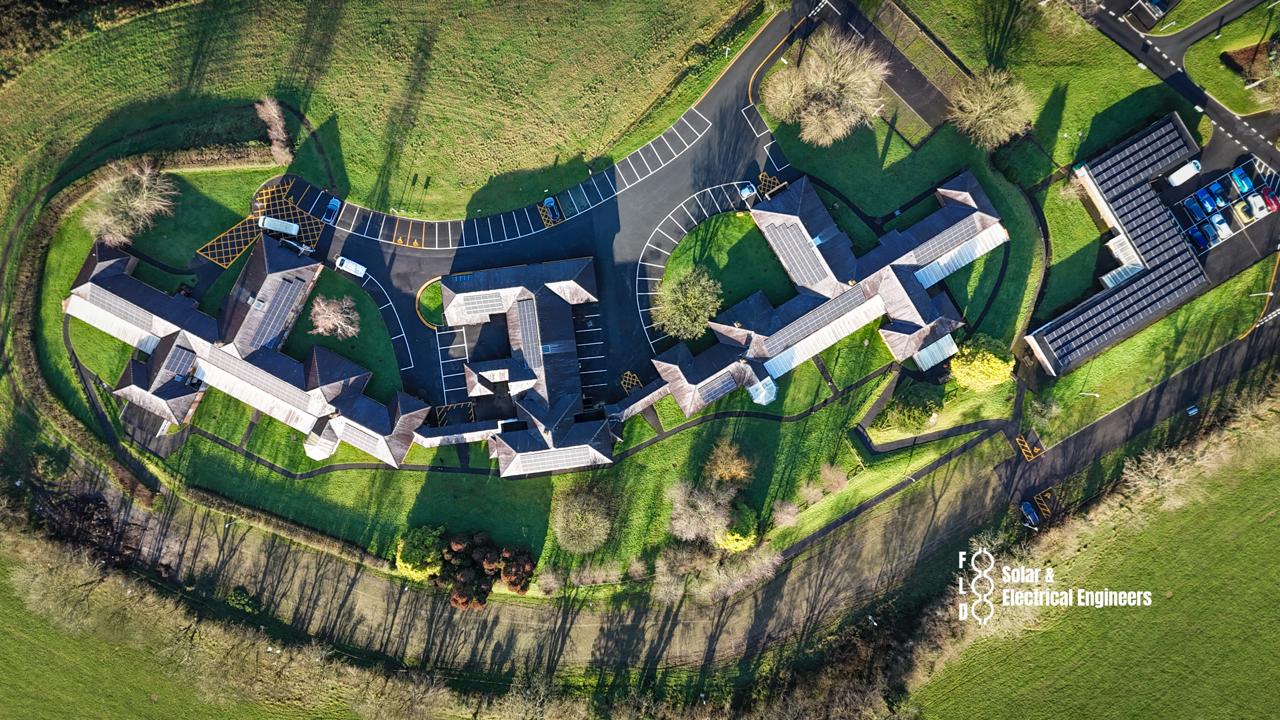
FLD uses string inverters for: unshaded large commercial and industrial roofs (warehouses, factories) where all panels face the same direction and shading is minimal.
SolarEdge with power optimisers: the South Wales standard
SolarEdge decouples individual panel performance from string performance. A power optimiser on each panel performs maximum power point tracking at panel level, then feeds a standardised DC voltage into the central SolarEdge inverter. One shaded panel no longer drags down its neighbours.
The SolarEdge platform also provides panel-level monitoring — visible in the SolarEdge monitoring app as a colour-coded roof layout showing each panel’s output in real time. FLD installs SolarEdge monitoring displays on all commercial installations above 30 kWp and recommends the app for domestic clients as the primary diagnostic tool.
Battery integration: SolarEdge StorEdge allows battery storage to be added without replacing the inverter. For domestic installations, this is the single most important long-term advantage over competitors — SolarEdge batteries installed today are compatible with SolarEdge systems installed in 2019. FLD specifies SolarEdge as the default domestic inverter platform precisely because of this upgrade path.
Cost premium: approximately £15 to £25 per panel over a string inverter for a domestic system. On a 12-panel domestic installation, the SolarEdge premium is £180 to £300 — recovered within the first 18 to 24 months on a shaded roof through improved output.
FLD uses SolarEdge for: all domestic installations, commercial rooftops with any shading complexity, and any installation where future battery retrofit is likely.
Microinverters: panel-level independence
Microinverters mount directly behind each panel and convert DC to AC at panel level. There is no central inverter to fail. Each panel operates as a fully independent unit. In theory, microinverter systems should be more resilient — a single microinverter failure affects only one panel rather than an entire string.
In practice, microinverters have a less robust long-term service and replacement ecosystem than SolarEdge in the UK market. The Enphase platform is the dominant microinverter brand with a strong UK service network. Microinverters are also slightly less efficient per unit than SolarEdge optimisers due to the AC conversion overhead at each panel.
Where microinverters make sense: complex multi-pitch roofs where panels face multiple orientations (east, south and west simultaneously), or installations where a central inverter enclosure cannot be accommodated in the internal space.
FLD uses microinverters for: east-west flat roof commercial arrays where two opposing strings feed simultaneous but non-identical generation profiles, and complex domestic roofs with three or more distinct orientations.
Hybrid inverters and battery-ready systems
Hybrid inverters combine the DC-AC conversion function with battery charge control in a single unit. The GivEnergy, Solis and SolarEdge hybrid inverter platforms are the most common in the UK domestic market in 2026.
For new domestic installations where battery storage is planned within 2 to 3 years, a hybrid inverter specified from the outset is marginally more cost-effective than a separate DC-coupled battery retrofit later. FLD recommends hybrid inverter specification for any domestic client who expects to add battery storage within 5 years.
Monitoring and diagnostics
All SolarEdge systems report to the SolarEdge monitoring portal. FLD installs the monitoring configuration at commissioning and provides clients with app login credentials. For commercial installations, FLD sets up email alerts for inverter faults and offers an annual performance review against PVGIS predicted generation.
String inverter systems from Fronius, SMA and Huawei provide string-level monitoring via manufacturer portals. Panel-level visibility requires add-on monitoring hardware on string systems.
Choosing at survey stage
FLD specifies inverter platform at survey stage based on roof geometry, shading analysis (using the SolarEdge Designer tool with satellite imagery), future battery intent and client budget. Where shading is absent and budget is a priority, string inverters remain valid. Where shading, monitoring or battery integration is a consideration — which covers the majority of South Wales domestic roofs — SolarEdge is the FLD default.
Call Paul on 07913 117746 or use the contact page to discuss inverter options for your property.