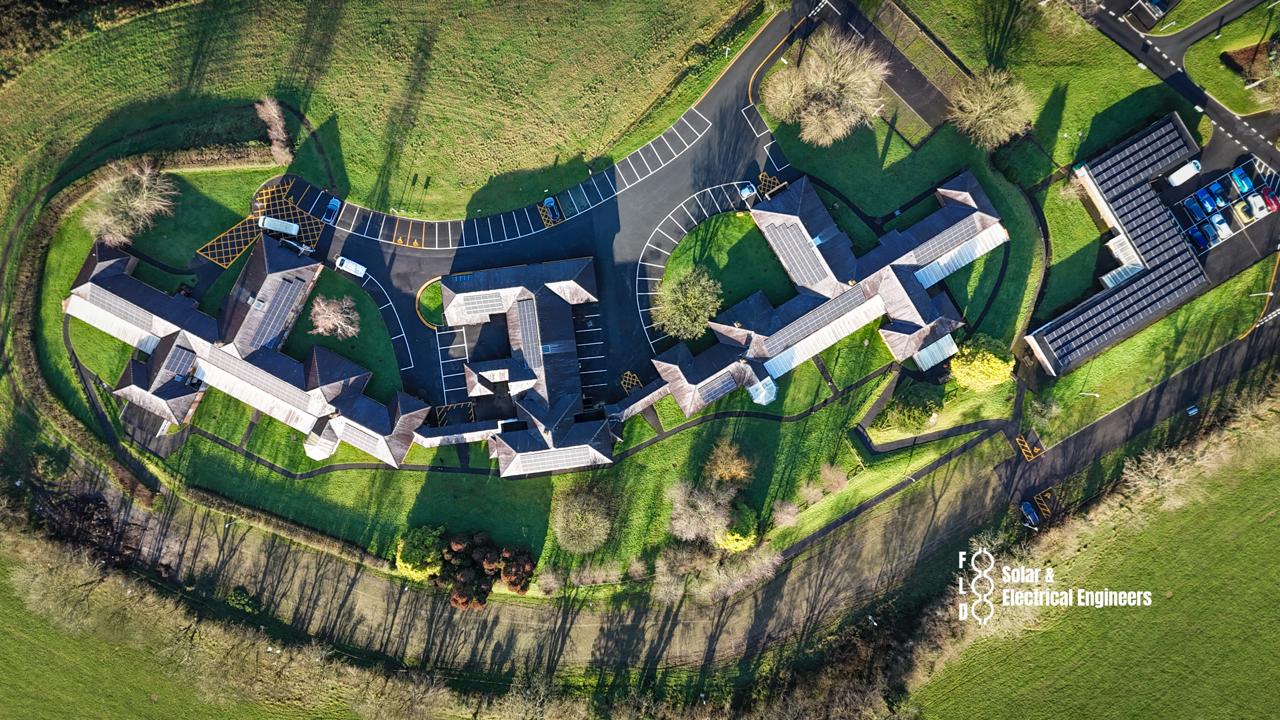
Every commercial solar quotation FLD produces specifies the inverter technology. For most of our South Wales commercial projects above 30 kWp, that means SolarEdge optimisers with a SolarEdge central inverter. For some smaller or simpler rooftops, a standard string inverter from a manufacturer like Sungrow or SMA is the better choice.
This is an honest breakdown of the difference, when each makes commercial sense, and why the choice matters more on a South Wales rooftop than it might on a clear, unobstructed field array.
What a string inverter does
A standard string inverter connects multiple panels in series. Electricity generated by each panel flows through the string to the inverter, which converts the combined DC output to AC. The fundamental limitation: if one panel in the string is shaded, dirty, or underperforming, the output of every other panel in that string is pulled down to match the weakest link.
On a perfectly oriented, completely unobstructed commercial roof, this matters very little. In practice, commercial rooftops rarely offer those conditions.
What SolarEdge adds
SolarEdge installs a power optimiser on each panel. The optimiser performs maximum power point tracking (MPPT) at the individual panel level, meaning each panel operates at its own optimal output regardless of what neighbouring panels are doing. A shadow from a parapet wall, a rooftop HVAC unit, or a soiling patch on a single panel no longer degrades the entire string.
The optimisers report panel-level performance data to the SolarEdge monitoring portal, which means every panel’s output is visible in near real-time. This has a practical benefit beyond shading: it is the most effective tool available for early identification of a failing panel, degraded string, or wiring fault.
What the yield difference looks like in South Wales
The yield improvement from optimisation versus a standard string inverter depends entirely on the shading profile of the roof. FLD’s experience across South Wales commercial installations:
- Unobstructed flat industrial roof, south-facing: 3 to 5% improvement from SolarEdge. Small but real, driven by panel-to-panel mismatch losses and temperature variation across a large array.
- Industrial roof with rooftop obstacles (HVAC, lifts, rooflights): 8 to 15% improvement, depending on the proportion of the array affected at different times of day.
- Pitched commercial roof with complex orientation or multiple aspects: 10 to 20% improvement, particularly on east/west split arrays where the two faces are at very different output levels through the day.
- Roof with significant nearby shading (adjacent buildings, trees, chimneys): 15 to 25% improvement in worst cases.
South Wales commercial rooftops typically sit in the second and third categories. Industrial estates built in the 1970s to 1990s tend to have HVAC units, ridge vents, and skylights scattered across the roof plane. Older town-centre commercial stock often has adjacent buildings that create shadow movement through the day.
The cost premium
SolarEdge hardware adds approximately £0.06 to £0.10 per Wp to the installed cost of a commercial system. On a 100 kWp system, that is £6,000 to £10,000 additional cost. On a 500 kWp system, the premium is larger in absolute terms but smaller as a percentage.
On a typical South Wales commercial roof with moderate obstacles, the yield improvement of 8 to 12% on a 100 kWp system generates an additional 7,600 to 11,400 kWh per year. At 29p/kWh self-consumption saving, that is £2,200 to £3,300 per year of additional benefit. The optimiser premium typically pays back within 2 to 4 years, on top of the solar system’s own payback.
When string inverters are the right choice
There are legitimate cases where a standard string inverter outperforms SolarEdge on a commercial cost-benefit basis:
- Very large, flat, completely unobstructed industrial roofs with identical panel orientation throughout. A modern logistics centre with 10,000 m2 of flat roof, no rooflights, and no HVAC on the roof is a reasonable string inverter case.
- Projects where the budget ceiling is firm and the incremental SolarEdge cost would push the system below a viable return threshold.
- Agricultural buildings where the primary objective is low capital cost and monitoring complexity is not valued.
For most urban and peri-urban South Wales commercial rooftops, SolarEdge is the right specification. FLD has standardised on it as the default partly because the monitoring data is commercially valuable: it satisfies ESOS Phase 4 sub-metering requirements for qualifying businesses, and it provides the evidence base for warranty claims and O&M contracts.
ESOS Phase 4 and panel-level monitoring
ESOS Phase 4 obligations affect any UK business with over 250 staff or over £44 million turnover. The scheme requires a comprehensive energy audit covering all significant energy consumption, and it gives credit for sub-metered monitoring systems. A SolarEdge installation with the monitoring portal configured provides exactly the metered renewable generation data that an ESOS auditor needs.
This is increasingly a procurement requirement from large commercial tenants in South Wales — particularly those in the Tata Steel supply chain, where Scope 3 reporting obligations are cascading to tier-2 and tier-3 manufacturers.
What we recommend and why
FLD specifies SolarEdge on the large majority of commercial projects above 50 kWp in South Wales. The monitoring data, the yield recovery on typical South Wales rooftop profiles, and the ESOS compliance benefit make the premium straightforward to justify. On very large, unobstructed new-build rooftops, we will model both options and present the honest comparison.
If you want to see a side-by-side comparison for your specific site, we can model both scenarios as part of our standard free quotation. Call Paul on 07913 117746 or submit an enquiry.