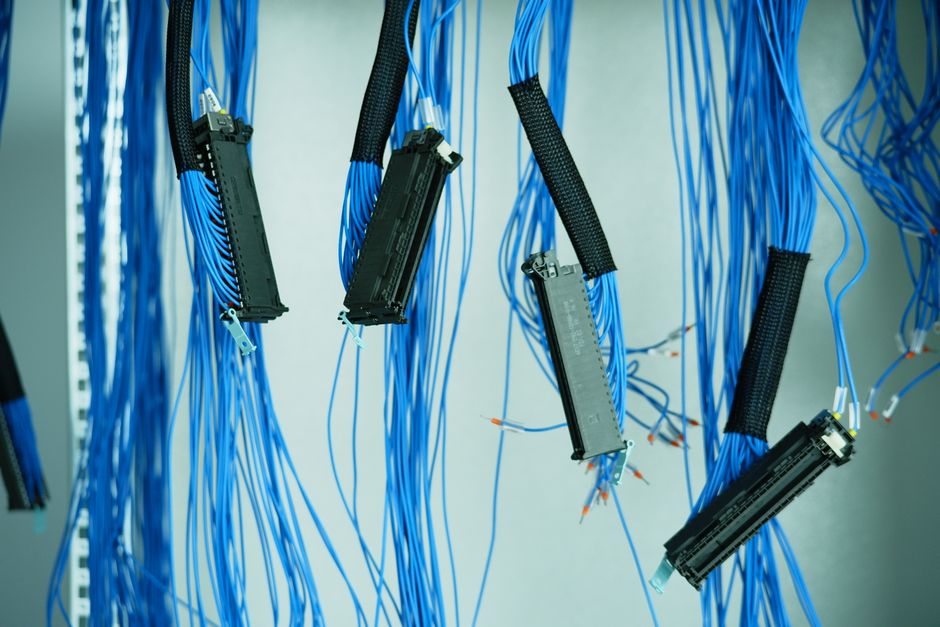
Structured cabling is the physical data and communications infrastructure of a commercial building — the cables, patch panels, data outlets and connection hardware that underpin every network-dependent system, from office Wi-Fi and IT to CCTV, access control, VoIP and building management. Getting the design right at installation stage eliminates costly remediation later when network demands increase, systems are added or standards evolve.
This guide covers the key design and specification decisions for structured cabling installations in South Wales commercial and industrial premises.
Copper versus fibre: choosing the backbone
Copper (Cat6a): Cat6a (Category 6 Augmented) is the current standard for horizontal cabling in commercial premises — the runs from patch panel to individual data outlets. Cat6a supports 10 Gigabit Ethernet at full 100-metre horizontal run lengths and is backwards compatible with all earlier standards. For most South Wales office and light industrial installations, Cat6a copper is the correct specification.
Cat6 (without the ‘a’) is still widely installed but supports 10GbE only to 55 metres. FLD specifies Cat6a as the minimum standard for all new commercial cabling projects — the marginal cost difference over Cat6 is small and the upgrade headroom is significant.
Fibre backbone: For runs exceeding 100 metres (between floors, between buildings, or across large factory floor areas), fibre is essential. FLD installs:
- OM4 multimode fibre for campus backbones up to 400 metres supporting 40/100GbE
- OS2 singlemode fibre for runs up to 40 km, required for inter-building runs in large industrial estates or between sites
Fibre backbone connects the building’s communications room (Main Distribution Frame, or MDF) to floor distribution frames (IDFs) on each floor or zone. Horizontal runs from IDF to desk are always copper.
Power over Ethernet (PoE) for IP systems
PoE allows network cables to carry electrical power as well as data, eliminating separate power supplies for:
- IP CCTV cameras (typically PoE+, 30W)
- Wireless access points (PoE+, 15 to 30W)
- IP telephone handsets (PoE, 15W)
- Access control readers and door controllers (PoE+, 30W)
- Door intercoms and video entry (PoE+, 30W)
FLD specifies all cabling infrastructure to support PoE and PoE+ loads from day one — this requires Cat6a cables rated for the thermal requirements of PoE power delivery and PoE-capable switches at the patch panel. Retrofitting PoE capability to Cat5e or inadequately rated Cat6 cabling can cause thermal degradation in cable bundles.
TIA-568 certification: what it means
TIA-568 (Telecommunications Industry Association 568) is the North American cabling standard that, alongside ISO/IEC 11801, defines performance requirements for structured cabling. A TIA-568 certified installation has been tested with a cable certifier measuring parameters including:
- Insertion loss (signal attenuation over the cable run)
- NEXT (Near End Crosstalk — interference between adjacent pairs)
- PS-NEXT (Power Sum Near End Crosstalk)
- Return loss (signal reflection)
- Propagation delay and delay skew
FLD issues TIA-568 test reports for all certified installations, produced by a Fluke DSX-600 cable analyser or equivalent. These reports are delivered to the client at handover and should be retained as part of the building’s technical file — they are required for warranty claims against the cable manufacturer and the installer, and for insurance purposes in the event of network failure.
BS EN 50173 is the European equivalent standard to TIA-568. Both standards are in regular use in South Wales commercial projects — FLD certifies to whichever standard the client or main contractor specifies.
Data room and communications room design
The building’s main communications room (MDF room or server room) requires:
- Rack infrastructure: 600mm or 800mm 19-inch racks with cable management
- Power distribution: Dedicated circuit with surge protection, ideally with UPS for critical systems
- Cooling: Active cooling if heat dissipation from network equipment exceeds 1 kW, which is typical for any server or switch density above small-office scale
- Access control: A key-controlled or card-access door, separate from general office access
- Cable entry: Sealed cable entry points with fire-stopping compliant with BS 9999
FLD designs and installs data room infrastructure from initial fit-out through to full rack build and cable management. For new-build commercial projects, FLD provides a communications room specification at the design stage that is handed to the main contractor as a package item.
Industrial cabling: factories and warehouse environments
Industrial structured cabling faces environmental challenges absent from office installations:
- High-flex Cat6a industrial cable is required in cable trays exposed to mechanical vibration
- IP-rated patch panels and sockets are required in wet or dusty areas (IP54 minimum)
- Screened (STP/FTP) cable is required in environments with significant electromagnetic interference (variable-speed drives, welding equipment, motor control panels)
- Cable separation from high-voltage power cabling must be maintained to prevent induction — BS 7671 requires a minimum 50mm separation or metal segregation
FLD has installed structured cabling in food production facilities, precision engineering workshops, and distribution warehouses across South Wales. Industrial cabling specifications are developed site-specifically based on the EMC environment and the IP rating requirements of the locations being served.
Getting a structured cabling assessment
FLD provides structured cabling design and installation across South Wales commercial and industrial premises. Call Paul on 07913 117746 or use the contact page.