Inspection and testing scope
- EICR Electrical Installation Condition Report to BS 7671 for commercial, industrial and residential
- PAT portable appliance testing
- Emergency lighting testing to BS 5266 Part 1 (monthly function test, annual discharge test)
- Fire alarm testing to BS 5839 Part 1 (weekly user test support, six-monthly and annual service)
- Thermographic surveys of switchgear, distribution boards and busbar
- Fixed wiring insulation resistance, earth continuity and polarity testing
Emergency lighting testing to BS 5266
Emergency lighting is the compliance item most often missed, because nothing looks wrong until the power goes off. BS 5266-1 sets two tests and they are not interchangeable:
- The monthly functional test. Every luminaire is switched to its battery supply briefly, and you confirm the lamp actually lights. It is a short test by design - long enough to prove the lamp and the changeover work, short enough that the battery is not left flat.
- The annual full-duration discharge test. Every luminaire runs on battery for its full rated duration - three hours on most commercial installations - and must still be providing the required illumination at the end of it. This is the test that finds tired batteries, and it is the one that gets skipped.
Both must be recorded. The log book, not the light, is what a fire officer or an insurer asks to see, and an installation with working lights and no records is treated as an untested installation.
We test emergency lighting alongside fixed-wire testing on the same visit wherever the intervals line up, which avoids paying twice to get an engineer to site. The output is the completed log, a schedule of any luminaires that failed to hold their duration, and a quotation for replacements - batteries and luminaires both fail predictably with age, so the failures cluster once an installation passes about the ten-year mark.
If your building has escape routes, an open area over 60 square metres, or a high-risk task area, this applies to you regardless of how new the building is.
What a commercial EICR costs in Wales, and what drives the price
There is no per-property price for a commercial EICR, because the unit of work is not the building — it is the distribution board and the circuits hanging off it. A single-board office suite and a factory with eight boards and three-phase machinery supplies are different jobs with the same name.
What actually moves the number:
- Number of distribution boards and final circuits — the primary driver, and the reason a walk-round beats a phone quote.
- Sampling rate. BS 7671 allows periodic inspection to be carried out on a sample of circuits. A cheap quote often hides a low sample percentage; we agree it with you in writing before we start, because it determines what the certificate is actually worth.
- Access and downtime. Testing requires circuits to be isolated. Out-of-hours or phased testing to protect production or trading hours costs more and is frequently worth it.
- Age and records. An installation with no previous certification, or with mixed additions over decades, takes longer to trace and schedule.
- Remedials. These are always quoted separately, never bundled into the inspection price. You should be able to accept the report and decline the remedial work.
Intervals are set by premises type rather than by us — five years for most commercial and retail, three for industrial, annually for higher-risk environments (see the table below). For Welsh rented dwellings the interval is fixed in law rather than by recommendation.
We quote a fixed price after a short scoping call or visit, and we cover the whole of South Wales from Swansea. As an NICEIC Approved Contractor we can also carry out and re-certify any C1 or C2 remedials, so a failed report does not mean starting again with a second contractor.
Intervals and obligations
| Premises type | Maximum EICR interval |
|---|---|
| Commercial (office, retail) | 5 years |
| Industrial | 3 years |
| Residential, privately-rented (Wales) | 5 years, per Fitness for Human Habitation (Wales) Regs 2022 |
| Caravan and leisure | 3 years |
| Petrol stations, marinas, swimming pools | Annual |
| Healthcare | Annual or per HTM 06-01 |
Welsh landlord context
- Renting Homes (Wales) Act 2016 places the fitness-for-human-habitation duty on the landlord of every occupation contract, with electrical safety one of the prescribed matters
- Renting Homes (Fitness for Human Habitation) (Wales) Regulations 2022 set the detail, mandatory since 1 December 2022: a valid EICR at all times, inspected at least every five years (sooner if the report specifies an earlier date), with a copy to the contract-holder within 14 days of the occupation date - and, for any inspection carried out after occupation, within 14 days of that inspection
- Welsh Housing Quality Standard 2023 binds social landlords to specified electrical safety obligations
FLD delivers all of the above under a single NICEIC Approved Contractor sign-off, with reports in your preferred format and follow-up remedials priced separately.
Our process
- 1Site survey
A named FLD engineer visits your site, measures the roof or installation zone, inspects the incoming supply and verifies load, structural integrity and orientation. For commercial sites we run a full discovery including half-hourly consumption data where available.
- 2Design and proposal
We produce a scaled layout, generation model using PVGIS data, financial model with simple and post-tax payback, DNO G99 or G98 notification pack where relevant, and a fixed-price quotation. Every proposal names the exact panels, inverters and mounting system.
- 3DNO and planning
We handle NGED G99 Type A applications for commercial systems, G98 notifications for domestic, and any permitted development confirmation or full planning submissions required for listed buildings or conservation areas.
- 4Install and commission
FLD directly-employed engineers install under a single NICEIC Approved Contractor sign-off. Commissioning includes BS 7671 testing, SolarEdge monitoring portal setup, MCS certification where applicable, and handover of all documentation.
- 5Aftercare
Insurance-backed NICEIC warranty, 25-to-30-year panel performance warranty from the tier-1 manufacturer, 12-year SolarEdge inverter warranty, and ongoing O and M support including remote performance monitoring.
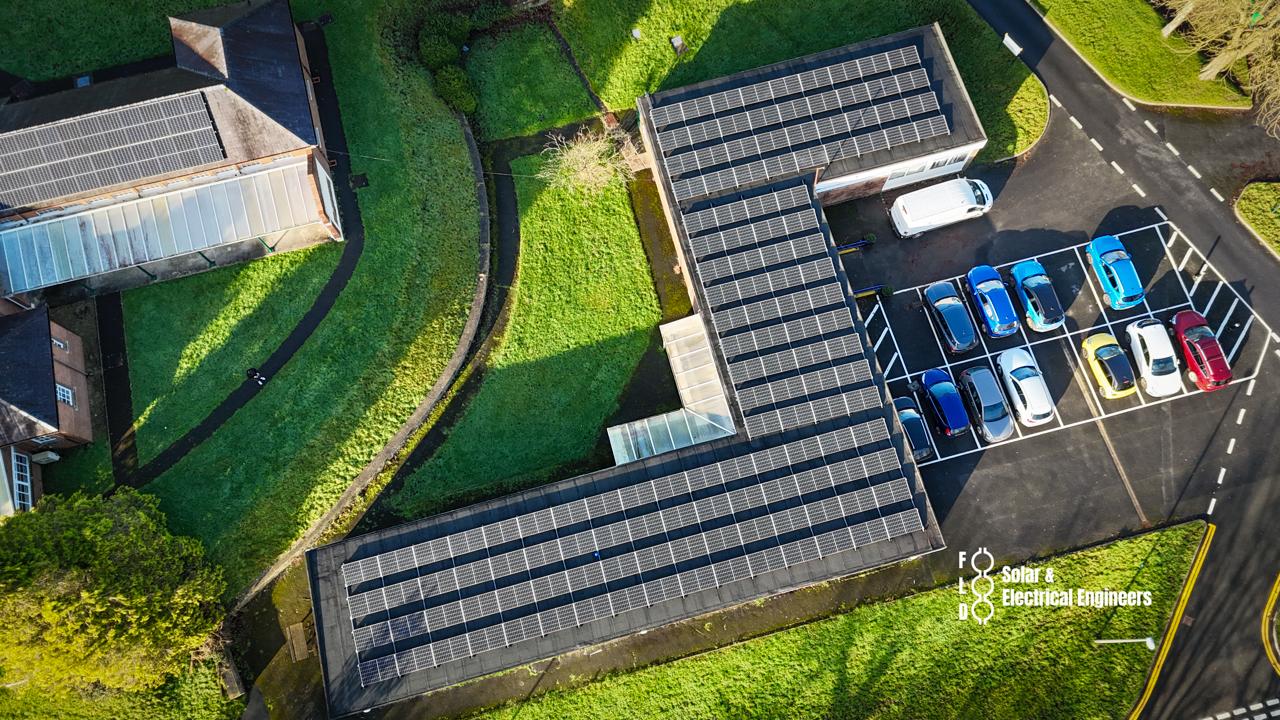
Roof-plant integration
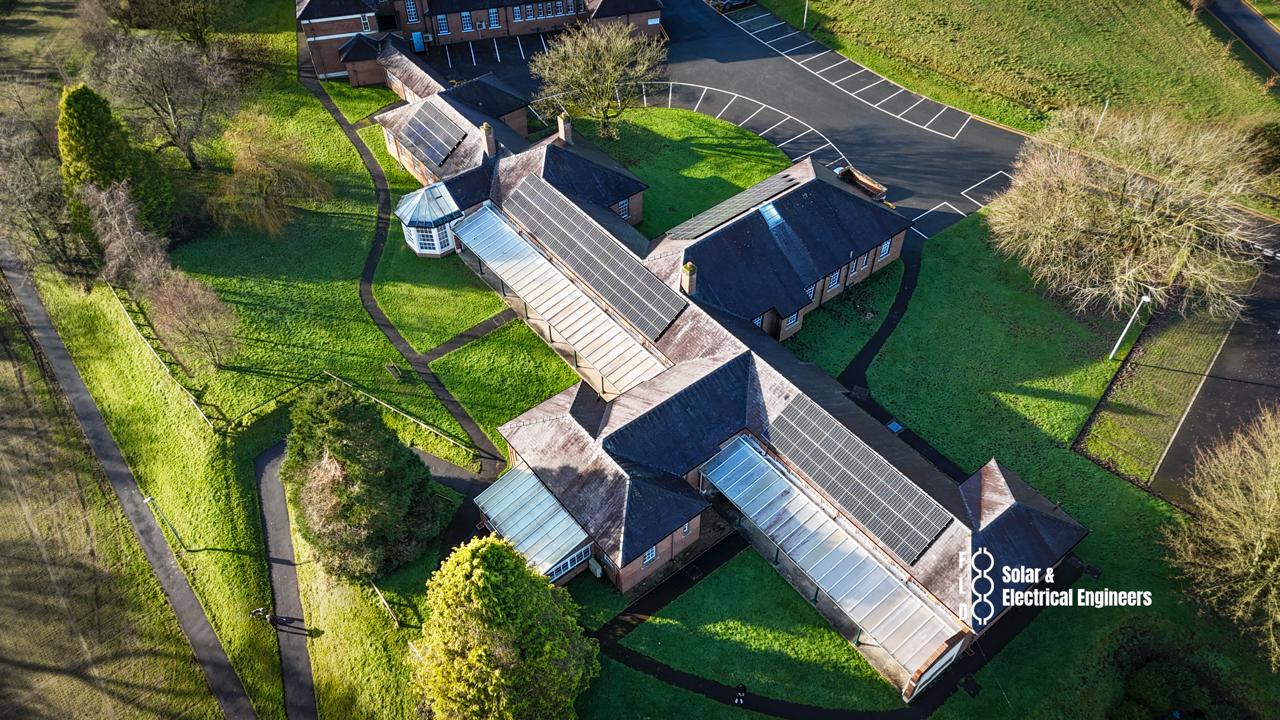
Pitched-roof array
Recent FLD installation — view all project photos
Standards we work to
- BS 7671
- BS 5266 Part 1
- BS 5839 Part 1
- HTM 06-01