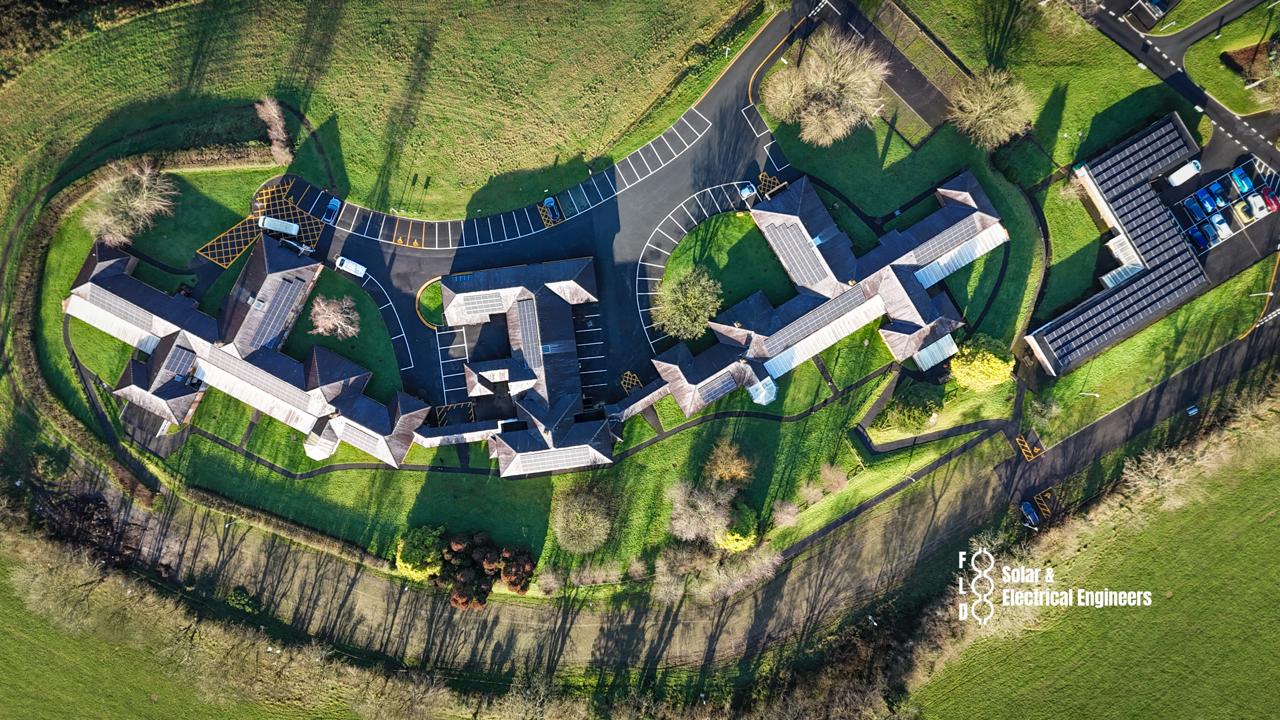
Serving Port Talbot
Port Talbot is the most consequential industrial location in Wales and one of the most significant in the whole United Kingdom. The 2021 census records a town population of 31,550, clustered around the Tata Steel Port Talbot Steelworks. The last blast furnace at Tata closed in October 2024, with approximately 2,000 staff remaining through the transition to an electric arc furnace route. A £1.25 bn UK Government and Welsh Government Transition Board package is underwriting that industrial change.
The Transition Board funding unlocks a very particular kind of commercial opportunity. Tier-2 and tier-3 supply-chain tenants across Baglan Energy Park at SA12 7AX, Water Street Business Park and Central Way are under explicit contractual Scope 3 pressure from downstream OEM customers. For many of them, commercial solar PV is the single quickest ESG win available. FLD is actively engaged with that programme.
The cultural profile of Port Talbot is unusually rich. The town has produced Anthony Hopkins, Richard Burton, Michael Sheen and Rob Brydon, giving it an acting heritage that is densely concentrated even by Welsh standards. Landmarks include Aberafan Beach, Margam Country Park with the Grade I listed Margam Castle and Orangery, and the Margam Stones Museum.
Beyond the steelworks, the local economy includes Baglan Energy Park (which Port Talbot shares with Neath), small-scale chemical manufacturers and a maritime services cluster. The Celtic Freeport designation granted in 2023, covering both Port Talbot and Milford Haven, compounds the tax-advantaged environment for inward investment in low-carbon industry.
At a yield of 955 kWh/kWp (marginally higher than Swansea due to the coastal exposure), a 500 kWp tenant rooftop generates 477,500 kWh per year. With the unusually high self-consumption of heavy industrial tenants (typically 80% or above), first-year benefit at 26p/kWh blended is in the region of £100,000. Simple payback sits at approximately 4.0 years on £400,000 capex, dropping to 2.9 years post-tax under AIA.
We are 18 minutes from Port Talbot. We hold ConstructionLine for Transition Board supply-chain framework bidding, and the commercial solar programme here is a strategic focus for the business.
Commercial sites and business parks
Very high energy intensityBaglan Energy Park
SA12 7AX
Water Street Business Park
Central Way
100 kWp reference system at 955 kWh/kWp
Modelled at 27p/kWh blended import, 12p/kWh SEG export, 80% self-consumption for very high energy intensity site.
Housing stock in Port Talbot
Victorian and Edwardian terraces, interwar semis, modern estates
A typical 4 kWp domestic install here generates 3,820 kWh/yr. With 40% self-consumption at 30p/kWh and 60% SEG export at 12p/kWh, first-year saving is approximately £733.
Local landmarks and context
- Aberafan Beach
- Margam Country Park
- Margam Stones Museum
Major employers we work with
- Tata Steel Port Talbot
- Baglan Energy Park tenants
Looking after solar and electrical systems in Port Talbot
A lot of our Port Talbot work is not new installations at all — it is looking after equipment somebody else put in.
Where a Port Talbot system exports more than it uses, commercial and domestic battery storage is what turns that export back into self-consumption, which is worth roughly double what the export tariff pays.
EV charger installation with load management is the other upgrade that pairs with an existing array in Port Talbot — charging off your own generation rather than off the grid changes the arithmetic completely.
On commercial premises in Port Talbot, LED lighting upgrades normally pays back faster than anything else on the building, and it cuts the load the solar has to cover in the first place.
Existing arrays around Port Talbot lose output quietly — soiling on the glass, a string that has dropped out, an inverter throwing a fault code nobody reads — so planned solar maintenance and cleaning is usually the first thing worth booking on a system that is a few years old.
We are 18 minutes from Port Talbot in normal traffic, which is why we can put an engineer on a fault the same week rather than the same month.
Recent local developments
- Tata electric arc furnace transition
- Celtic Freeport activation
- £1.25bn Transition Board package