Skip to content

Services

Commercial Solar PPA in Wales: Zero Upfront Cost

Install up to 1 MW of rooftop or ground-mount solar on your business premises with no capital outlay. Buy the electricity at a fixed rate below your grid tariff.

How a Power Purchase Agreement works

A PPA is a financing structure, not a product. FLD and our finance partner fund, install, own and maintain the solar system on your roof. Your business signs a long-term electricity supply agreement for the energy the system produces, at a fixed rate that is lower than your current grid tariff and that rises only with RPI.

  • You pay nothing upfront. No capex, no balance-sheet asset.
  • You save from day one. The PPA unit rate is set below grid import.
  • Term: 10 to 25 years, with buy-out or assignment options.
  • End of term: extend, buy the system at residual value, or have it removed.

Decision matrix

Criterion PPA Self-finance (AIA) Asset finance
Upfront cost £0 Full capex Deposit plus monthly
Savings profile Immediate, smaller margin Immediate, full margin Positive after term
Balance sheet Off On On (lease) or Off (HP)
Best for Cashflow-sensitive, multi-site High-margin businesses Middle ground

Indicative unit rates

Subject to site survey, credit check and DNO Type A approval, FLD PPAs in 2026 are typically pricing at:

  • 9 to 11p/kWh fixed year one, RPI-indexed annually
  • Against a current commercial grid import of 28 to 32p/kWh

Savings scale with self-consumption. A 70%-consumption site on a 100 kWp system typically sees first-year savings of £13,000 to £17,000 with zero capex.

Prerequisites

  • Trading entity with two years of filed accounts
  • Credit check minimum threshold
  • Owner-occupier or long lease (minimum term matches PPA term)
  • Suitable roof: structural capacity, orientation between east-south-west, no major shading
  • DNO G99 Type A connection approval (we manage this)

What we do

  • Commercial and technical feasibility
  • Heads of Terms and full PPA drafting
  • Installation to BS 7671 and MCS-equivalent standards
  • Ongoing operation and maintenance for the term
  • Performance guarantee linked to insured metered generation

Our process

  1. 1
    Site survey

    A named FLD engineer visits your site, measures the roof or installation zone, inspects the incoming supply and verifies load, structural integrity and orientation. For commercial sites we run a full discovery including half-hourly consumption data where available.

  2. 2
    Design and proposal

    We produce a scaled layout, generation model using PVGIS data, financial model with simple and post-tax payback, DNO G99 or G98 notification pack where relevant, and a fixed-price quotation. Every proposal names the exact panels, inverters and mounting system.

  3. 3
    DNO and planning

    We handle NGED G99 Type A applications for commercial systems, G98 notifications for domestic, and any permitted development confirmation or full planning submissions required for listed buildings or conservation areas.

  4. 4
    Install and commission

    FLD directly-employed engineers install under a single NICEIC Approved Contractor sign-off. Commissioning includes BS 7671 testing, SolarEdge monitoring portal setup, MCS certification where applicable, and handover of all documentation.

  5. 5
    Aftercare

    Insurance-backed NICEIC warranty, 25-to-30-year panel performance warranty from the tier-1 manufacturer, 12-year SolarEdge inverter warranty, and ongoing O and M support including remote performance monitoring.
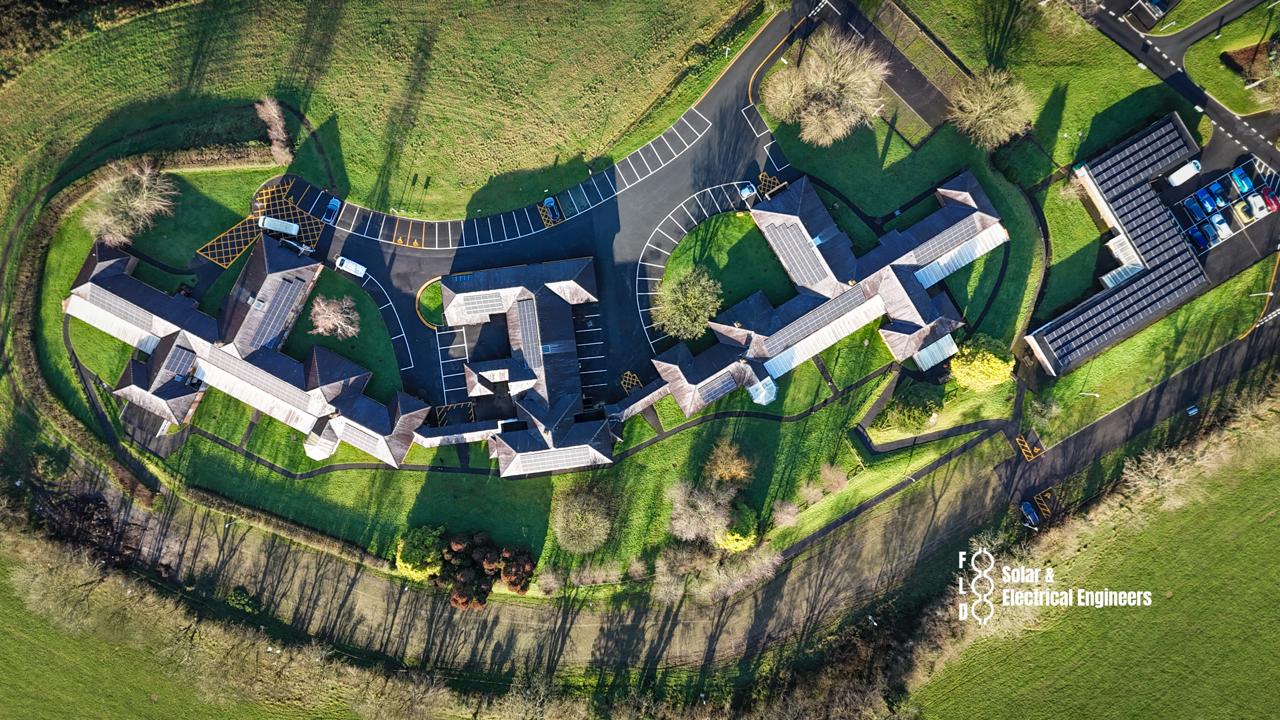
Completed commercial rooftop solar array installed by FLD Solar & Electrical

180 kWp commercial rooftop array, South Wales — FLD installation

Solis 5G Series commercial solar inverters in plant room
Solar panel installation in progress on industrial facility roof

Recent FLD installation — view all project photos

Standards we work to

  • BS 7671
  • G99 Type A
  • IEC 61215
  • IEC 61730

Equipment and components

  • SolarEdge
  • Trina Vertex
  • JA Solar DeepBlue
Coverage

Commercial Solar PPA in Wales: Zero Upfront Cost available in

FAQ

Frequently asked questions

A Power Purchase Agreement is a financing arrangement where we fund and install a rooftop solar system at no upfront cost. Your business buys the electricity the system generates at a fixed, RPI-indexed rate that is lower than your grid tariff. The PPA typically runs 10 to 25 years. At the end you can extend, buy out at a pre-agreed residual value, or have the system removed. It suits businesses that want immediate savings without capital outlay and that are credit-worthy with a stable site.
Yes. Our PPAs are written to allow assignment to a new occupier or a buy-out at a pre-agreed residual value if you relocate. We work through these heads of terms at the agreement stage so there are no surprises. The system itself can also be uninstalled and relocated at your cost if the economics justify it, although in practice buy-out or assignment is far more common.
Once DNO G99 connection approval is in place and materials are on site, a typical 100 kWp rooftop install takes 5 to 8 working days. The critical-path item is usually the NGED Type A connection approval, which is 3 to 6 months in South Wales in 2026. We manage that application as part of our scope.
At 30p/kWh grid electricity, a 100 kWp system generating 95,000 kWh/yr with 70% self-consumption delivers around £24,000 of year-one benefit against c. £85,000 capex, a 3.5-year simple payback. Under Annual Investment Allowance first-year 100% relief, post-tax payback is closer to 2.6 years. South Wales yields 940 to 985 kWh/kWp/year depending on postcode, comfortably enough for commercial solar to be cashflow positive from month one with a PPA.
We specify SolarEdge inverters with Trina Vertex or JA Solar DeepBlue panels as our standard stack. SolarEdge string optimisers give panel-level monitoring and isolate shading losses. Trina and JA are both tier-1 bankable manufacturers with 25 to 30-year performance warranties. For specific projects we can specify alternative tier-1 brands if building, warranty or finance requirements dictate.
Yes, depending on organisation type. Welsh SMEs and public bodies can access the Welsh Government Energy Service, Ynni Cymru Capital Grants (approximately £10 m in 2026-27, £25,000 to £1 m per project) and Development Bank of Wales Green Business Loans. Welsh public-sector bodies use Salix Wales Funding Programme rather than the English Public Sector Decarbonisation Scheme. Farms may be eligible under Farming Connect. Always check current-year terms before committing.
G99 is the Engineering Recommendation governing how generation equipment connects to the UK distribution network. For commercial solar above 16 A per phase, you need G99 approval from your District Network Operator before export. In South Wales that is National Grid Electricity Distribution (NGED, formerly Western Power Distribution). Type A connections are the standard sub-1 MW route, typically 3 to 6 months in 2026.

Ready for a fixed-price quotation?

Speak to Paul directly. Most quotes turn around within five working days of a site survey.

Trusted by NHS care providers, HMCTS and private developers across South Wales.