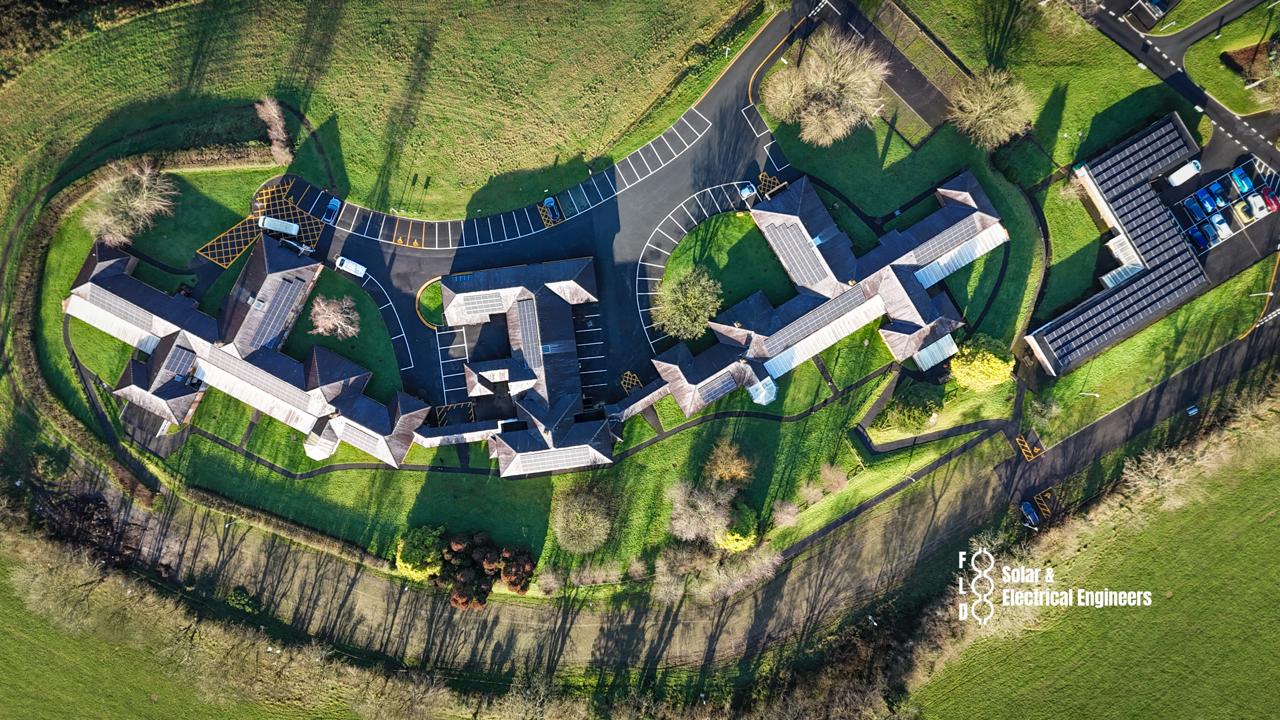
Serving Cardigan
Cardigan -- Aberteifi in Welsh -- is the principal market town of south Ceredigion, sitting at the mouth of the River Teifi where it meets Cardigan Bay. The population of approximately 4,200 belies the town's regional commercial reach: Cardigan serves a farming hinterland that runs east along the Teifi valley as far as Lampeter and north toward Aberystwyth, making it the trade and service centre for a large rural Ceredigion catchment.
Ceredigion County Council administers the area. The coastal position on Cardigan Bay produces a solar yield of 985 kWh/kWp -- the same as Haverfordwest and well above the South Wales inland average -- because the bay's maritime exposure provides open western sky and reduced cloud cover compared to the inland valleys. For a solar installer, the Cardigan coastline represents some of the most consistently high-yield rooftops in Ceredigion.
The economic character blends coastal tourism, agricultural supply, and a growing Welsh-language creative and digital sector. Cardigan Castle is the centrepiece of the town -- extensively restored between 2003 and 2015 and now operating as a boutique hotel, events space and cultural venue. It was the site of the first National Eisteddfod in 1176. The castle operation provides a useful model for heritage-listed commercial solar: the roof restoration programme incorporated in-roof integrated panels on the non-public-facing hotel accommodation wings.
Commercial floorspace includes Parc Teifi Business Centre on the eastern edge of town and the independent retail stock along Pendre and High Street. The agricultural supply merchants serving the Teifi valley farm base -- seed merchants, agricultural engineers, feed co-operatives -- are concentrated toward the Finch Square area and represent consistent daytime-load energy users suited to commercial rooftop solar.
Farming Connect grant uptake in the SA43 postcode is among the highest in Ceredigion per farm holding, driven partly by the strong Farming Connect officer presence in the county and partly by a local farming community that has been engaged with the Sustainable Farming Scheme planning process since 2022.
At 985 kWh/kWp, a 50 kWp farm-building installation east of Cardigan generates 49,250 kWh per year. With 75% self-consumption on a dairy and beef holding at 27p/kWh, first-year saving reaches approximately £11,800 on £47,000 capex. Farming Connect at 40% reduces net capex to £28,200; post-grant AIA payback approximately 2.1 years.
FLD reaches Cardigan in approximately 95 minutes from Swansea via the A484 and A487. Coverage here is planned as a full Ceredigion day combining with Lampeter and Aberystwyth.
Commercial sites and business parks
Medium energy intensityParc Teifi Business Centre
100 kWp reference system at 985 kWh/kWp
Modelled at 27p/kWh blended import, 12p/kWh SEG export, 65% self-consumption for medium energy intensity site.
Housing stock in Cardigan
Market-town Georgian and Victorian centre, inter-war semis, rural farmhouses and cottages
A typical 4 kWp domestic install here generates 3,940 kWh/yr. With 40% self-consumption at 30p/kWh and 60% SEG export at 12p/kWh, first-year saving is approximately £756.
Local landmarks and context
- Cardigan Castle (first National Eisteddfod 1176)
- River Teifi
- Cardigan Bay coastline
Major employers we work with
- Cardigan Castle hotel and events
- Parc Teifi Business Centre tenants
- Agricultural supply SMEs
Looking after solar and electrical systems in Cardigan
The jobs that keep bringing us back to Cardigan tend to be maintenance and upgrades rather than first fits.
EV charger installation is the other upgrade that pairs with an existing array in Cardigan — charging off your own generation rather than off the grid changes the arithmetic completely.
On commercial premises in Cardigan, commercial LED lighting upgrades normally pays back faster than anything else on the building, and it cuts the load the solar has to cover in the first place.
Existing arrays around Cardigan lose output quietly — soiling on the glass, a string that has dropped out, an inverter throwing a fault code nobody reads — so solar panel cleaning and O&M is usually the first thing worth booking on a system that is a few years old.
Where a Cardigan system exports more than it uses, battery storage sized to the actual load is what turns that export back into self-consumption, which is worth roughly double what the export tariff pays.
We are 95 minutes from Cardigan in normal traffic, which is why we can put an engineer on a fault the same week rather than the same month.
Recent local developments
- Cardigan Castle restoration and hotel opening
- Ceredigion Farming Connect grant rounds
- Teifi valley active travel