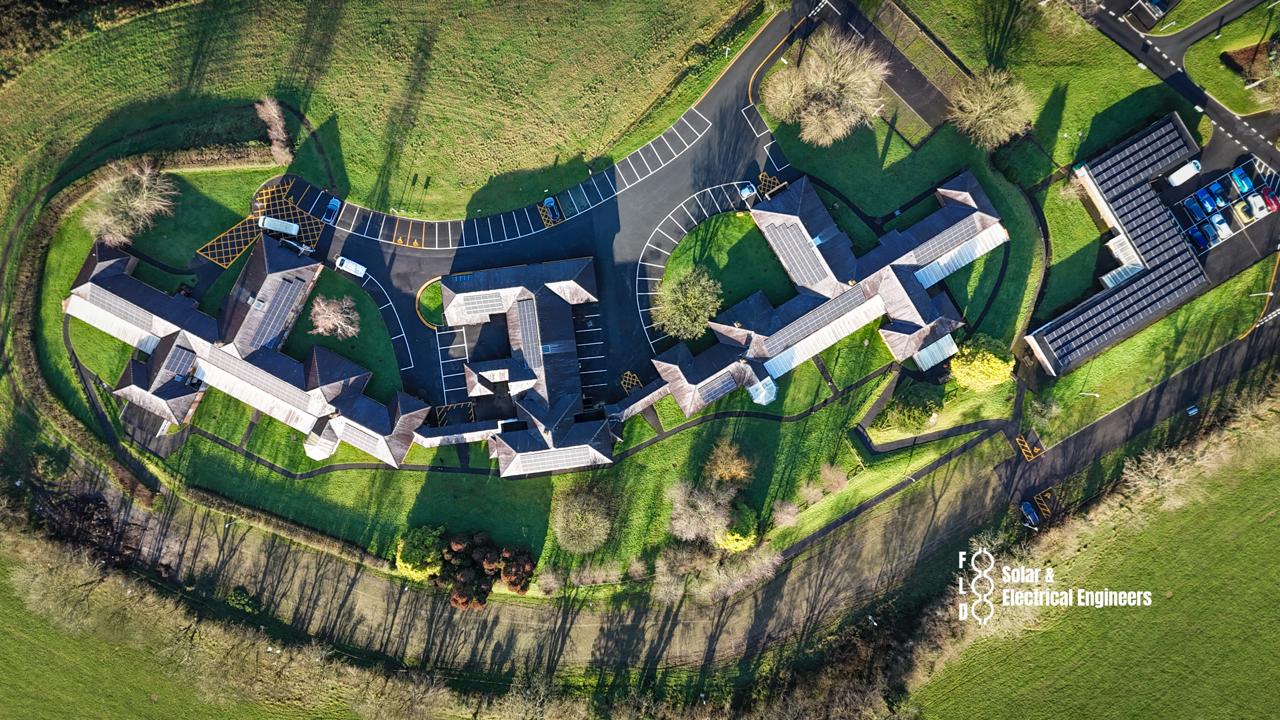
Narberth is Pembrokeshire’s food and independent business capital — a reputation built on the Queen’s Hall market, the independent hospitality cluster around High Street and Spring Gardens, and the growing food production and rural enterprise economy in the SA67 hinterland. Commercial solar in Narberth combines the town’s boutique hospitality economy with a substantial rural enterprise and agricultural pipeline across east Pembrokeshire.
SA67 commercial yield: the Pembrokeshire premium
PVGIS data for SA67 returns 980 to 990 kWh/kWp — within the broad Pembrokeshire Atlantic yield band that places the county among the highest solar yield areas in Wales. For commercial properties in SA67, the yield premium over a Cardiff or Swansea installation generates approximately 4,000 to 5,000 kWh of additional annual generation on a 100 kWp system — worth approximately £1,200 to £1,500 per year.
Narberth town: food and independent hospitality
The Queen’s Hall, the Ultracomida deli and wine shop, Ultracomida restaurant and the wider High Street independent cluster have established Narberth as Pembrokeshire’s premium food destination. These businesses carry modest roof areas but high daytime electricity loads from refrigeration, kitchen equipment and servery systems — producing self-consumption rates of 65% to 75% on well-sited small arrays.
For a typical Narberth town-centre restaurant or deli operating from owned or long-leasehold premises, a 20 kWp to 40 kWp installation represents the practical range given roof constraints. AIA tax credit makes the financial case clear: a £32,000 installation generates an £8,000 first-year Corporation Tax credit, reducing effective capex to £24,000 and producing a post-tax payback of 4.2 to 4.8 years.
Rural SA67: the agricultural enterprise case
The SA67 rural catchment — farms across the Daugleddau estuary hinterland and the eastern Preseli foothills — carries a diverse agricultural economy including dairy, poultry, mixed arable and farm diversification businesses. Farming Connect capital grants of up to 40% are available for agricultural building solar, dramatically improving the post-grant payback for qualifying farm holdings.
A 60 kWp dairy farm installation in SA67 at 985 kWh/kWp generates 59,100 kWh annually. At 72% self-consumption, year-one benefit: approximately £13,600. On £52,200 installed cost before Farming Connect grant, post-40% grant payback: 2.3 years.
FLD provides Farming Connect-formatted feasibility reports for qualifying SA67 agricultural clients.
Conservation planning in Narberth town
Narberth town centre carries listed buildings and a conservation area designation. FLD applies the same pre-application consultation approach as at Tenby and Pembroke: in-roof integrated solar for conservation-sensitive frontages, written confirmation of planning position before survey commitment. For SA67 agricultural buildings outside the conservation designation, standard on-roof framed installations are the norm.
SP Manweb and rural SA67 connections
SA67 is SP Manweb territory. G99 Type A approval timelines run at 14 to 20 weeks. Rural SA67 distribution circuits in the Preseli Hills area can be constrained single-phase feeders — FLD runs SP Manweb pre-application checks for all rural SA67 proposals above 30 kWp and specifies blackout-rated battery storage as standard for isolated rural properties.
Ynni Cymru for SA67 businesses
Narberth and SA67 businesses registered in Wales qualify for Ynni Cymru capital grants of £25,000 to £1,000,000. Rural enterprise, food production and tourism businesses are all eligible. FLD assists with pre-application feasibility documentation.
Getting a Narberth survey
FLD covers SA67 on Pembrokeshire coastal survey days. Rural properties with complex roof structures should allow additional survey time. Call Paul on 07913 117746 for a no-cost assessment.