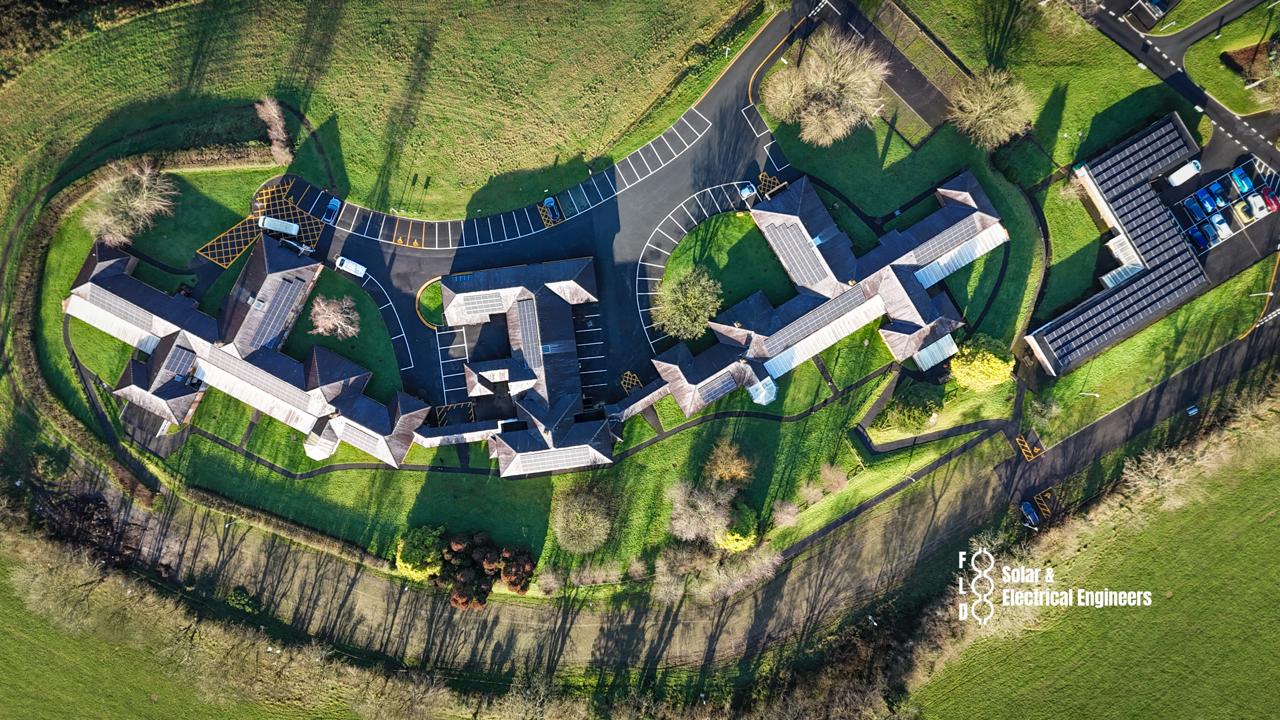
Serving Lampeter
Lampeter -- Llanbedr Pont Steffan in Welsh -- is a small market town in southern Ceredigion with a population of approximately 3,100, notable for hosting the University of Wales Trinity Saint David's Lampeter campus, the oldest degree-awarding institution in Wales and among the oldest in Britain, granted its Royal Charter in 1828.
The town's character is shaped by the intersection of a rural agricultural hinterland and a university community. Ceredigion County Council administers the area. The surrounding countryside is dominated by sheep and dairy farming along the Teifi valley, with a belt of small-holder and mixed-holdings rising to the east into the Cambrian Mountains. This agricultural context is the primary commercial solar driver for FLD -- Farming Connect grants and Sustainable Farming Scheme co-investment are actively funding farm solar installations across the SA48 hinterland.
University of Wales Trinity Saint David's Lampeter campus is a stone-built historic complex with a Victorian quadrangle. The campus carries an active sustainability estate programme, and Salix Wales funding has been applied to several Welsh university buildings in recent years. Commercial solar on the university estate would represent a Salix-funded public-sector installation with strong precedent from FLD's Swansea secondary school case study.
The town centre runs along High Street and Bridge Street, with independent retail, a weekly market, and a cluster of Welsh-language cultural organisations. Aberaeron is 14 miles west and Carmarthen 28 miles south, making Lampeter the service centre for a large rural catchment.
Landmarks include St Peter's Church (the original university building), the Lampeter Book Festival (held annually at the university), and the surrounding Teifi valley landscape. The Teifi Valley Railway heritage line runs from Henllan to the north-east, attracting recreational visitors.
For domestic solar, Lampeter's housing mix of Victorian and Edwardian town-centre terraces plus the substantial rural farmhouse stock within the delivery radius creates a varied but consistently solar-suitable installation base. At 960 kWh/kWp yield, a 4 kWp domestic system generates 3,840 kWh annually. Battery storage is particularly valuable here -- rural grid connections in SA48 carry a higher frequency of supply interruptions than urban areas, and a blackout-rated battery provides both economic optimisation and grid-resilience.
FLD reaches Lampeter from Swansea in approximately 70 minutes via the A485. The town combines naturally with Carmarthen and Llandovery on a Tywi-Teifi valley circuit.
Commercial sites and business parks
Medium energy intensityLampeter Business Park
100 kWp reference system at 960 kWh/kWp
Modelled at 27p/kWh blended import, 12p/kWh SEG export, 65% self-consumption for medium energy intensity site.
Housing stock in Lampeter
Victorian and Edwardian town-centre terraces, university accommodation, rural farmhouses
A typical 4 kWp domestic install here generates 3,840 kWh/yr. With 40% self-consumption at 30p/kWh and 60% SEG export at 12p/kWh, first-year saving is approximately £737.
Local landmarks and context
- UWTSD Lampeter campus
- Lampeter Book Festival
- St Peter's Church
- Teifi valley
Major employers we work with
- University of Wales Trinity Saint David Lampeter
- Ceredigion CC
- Agricultural SMEs
Looking after solar and electrical systems in Lampeter
Once a system is on the roof in Lampeter, the question changes from "what will it cost" to "who looks after it".
On commercial premises in Lampeter, an LED lighting replacement normally pays back faster than anything else on the building, and it cuts the load the solar has to cover in the first place.
Existing arrays around Lampeter lose output quietly — soiling on the glass, a string that has dropped out, an inverter throwing a fault code nobody reads — so solar maintenance, cleaning and thermographic surveys is usually the first thing worth booking on a system that is a few years old.
Where a Lampeter system exports more than it uses, adding battery storage is what turns that export back into self-consumption, which is worth roughly double what the export tariff pays.
workplace and home EV charging is the other upgrade that pairs with an existing array in Lampeter — charging off your own generation rather than off the grid changes the arithmetic completely.
We are 70 minutes from Lampeter in normal traffic, which is why we can put an engineer on a fault the same week rather than the same month.
Recent local developments
- UWTSD campus sustainability programme
- Farming Connect Ceredigion grant round
- Teifi Valley Path development