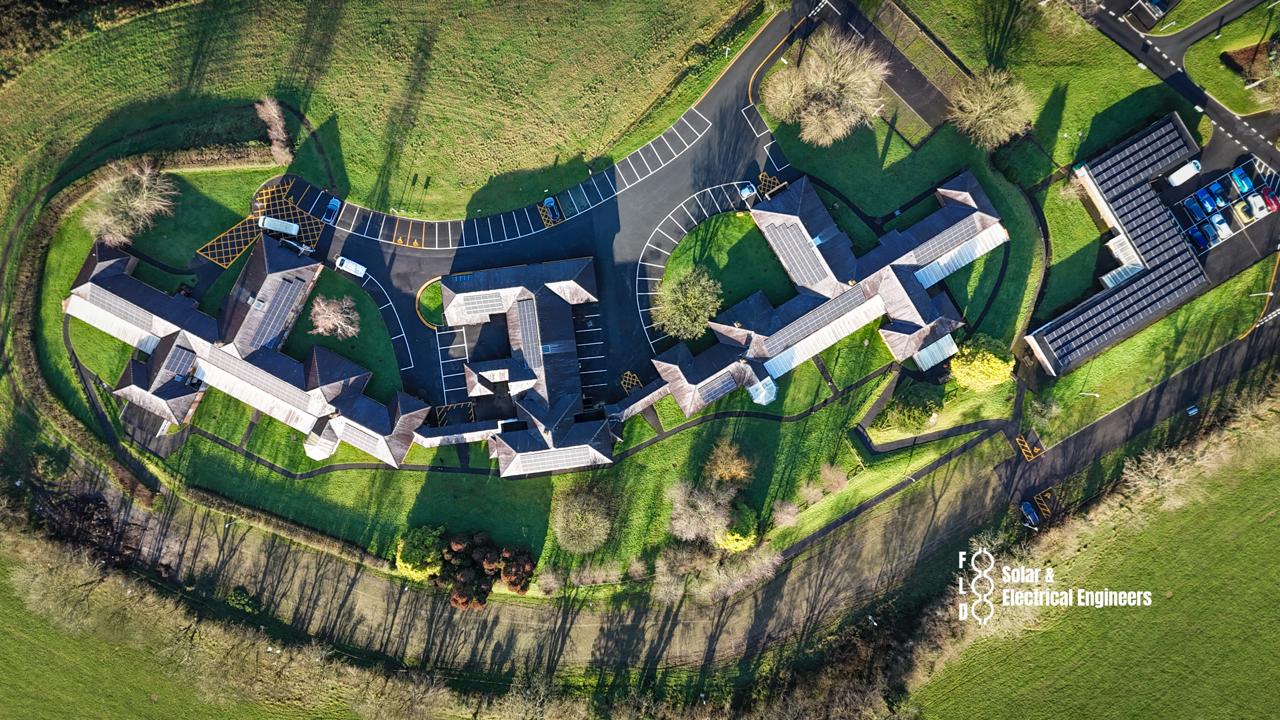
The M4 logistics corridor from Bridgend through Cardiff to Newport hosts some of the largest single-footprint warehouse roofs in Wales. Queensway Meadows (Amazon fulfilment), Imperial Park at Coedkernew, and the 32-hectare Mamhilad Park Estate near Pontypool each carry multiple buildings over 10,000 m2. Night-shift loading profiles mean that behind-the-meter self-consumption is often below 60%, which is where batteries start to pay back.
Typical systems and economics
| System size | Annual generation | Annual saving | Simple payback | Post-tax payback |
|---|---|---|---|---|
| 500 kWp | 475,000 kWh | £110,000 | 4.3 yrs | 3.1 yrs |
| 1 MW | 950,000 kWh | £220,000 | 4 yrs | 2.9 yrs |
- 500 kWp: Ballasted flat-roof, 60% self-consumption
- 1 MW: Battery storage recommended
Grants and finance
Third-party logistics operators are increasingly bound by customer-led net-zero contract clauses. Amazon, DHL, XPO and Wincanton all publish Scope 3 requirements that flow down to tenant operators. Welsh Government Energy Service and Development Bank of Wales Green Business Loans are both in scope for mid-sized operators.
Further reading
Commercial solar for Vale of Glamorgan businesses: Barry Docks, Cowbridge conservation area and the CF postcode guide
A commercial and domestic solar guide for the Vale of Glamorgan -- Vale of Glamorgan Business Park at Barry, Cowbridge conservation area domestic solar, and payback examples across CF62, CF63 and CF71.
Commercial solar in the M4 corridor: Cwmbran, Newport and the Torfaen-Monmouthshire industrial guide
Commercial solar economics for the M4 corridor from Newport to Cwmbran -- Llantarnam Industrial Park 24-hour logistics, Newport M4 distribution parks, and payback examples across NP44 and NP20.
Commercial solar for South Wales warehouses: logistics, 3PL operators and big-shed payback
How South Wales warehousing and logistics operators are using commercial solar to cut energy costs across large roof areas -- with payback models for 300 kWp to 750 kWp installations on distribution sheds.