The Gower Peninsula was Britain’s first Area of Outstanding Natural Beauty, designated in 1956. That status brings specific planning controls that do not apply to the rest of South Wales, and they affect every solar installation within the designated boundary — from a single domestic array on a house in Reynoldston to a commercial installation on a farm near Llangennith.
This is the definitive practical guide for 2026. If you are considering solar on Gower, read this before commissioning any quotes.
The Gower AONB boundary
The AONB boundary runs roughly from Swansea Bay in the east (excluding the urban areas of Sketty, Uplands, and Mumbles town centre) across the peninsula to the Loughor Estuary in the north. The boundary is not obvious from the ground — it passes through residential streets in some areas, splitting adjacent properties into AONB and non-AONB designations.
The City and County of Swansea planning authority maintains a GIS-accessible mapping tool. Before assuming a property is inside or outside the AONB, check the boundary map. FLD checks every Gower installation address before committing to a specification.
Domestic solar: what is permitted development inside the AONB
For houses within the Gower AONB, the Town and Country Planning (General Permitted Development) (Amendment) (Wales) Order applies, but with an important modification: solar panels are not permitted development on roofs that are visible from a public road or footpath.
In plain English, this means:
- A rear-facing array on a house where the rear roof is not visible from any public highway or PROW: likely permitted development, subject to standard conditions
- A front-facing or side-facing array visible from the road: requires planning permission
- A rear-facing array on a house where the garden and rear elevation are visible from a coastal path or AONB footpath: likely requires planning permission
The PROW network on Gower is dense. Coastal path sections run along cliff edges that overlook private gardens from above. This means some rear-facing installations that would be permitted development elsewhere on the Gower require planning because they are visible from a footpath that happens to be above the property.
What Swansea Council looks for in a planning application for AONB solar
If your installation requires planning permission, Swansea Council will assess it against three criteria:
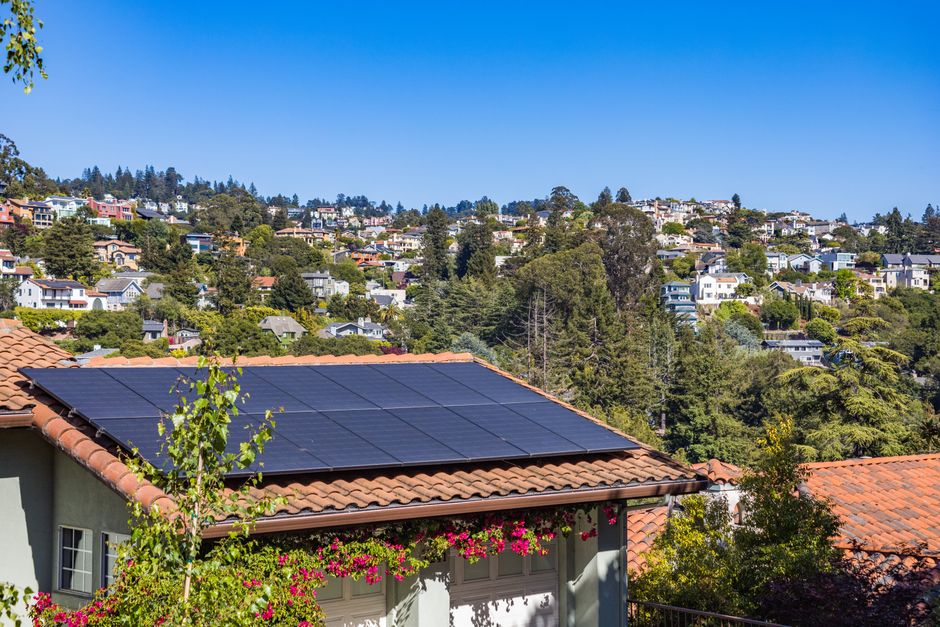
1. Visual impact on the AONB character The Gower Landscape Management Plan describes the peninsula’s character as dominated by natural, open landforms and historic settlement patterns. A solar installation should be sited to minimise visual intrusion. Low-profile, in-roof integrated panels (sitting flush with the roof plane rather than racked above it) are significantly more likely to be approved than conventional on-roof frames.
2. Colour and reflectivity Highly reflective panels can create glare and are sometimes refused on landscape grounds. All-black panels with anti-reflective coating are the preferred specification for AONB applications. FLD specifies all-black panels as standard on Gower domestic installations.
3. Reversibility The planning authority is likely to condition an approval to require removal of the installation if the property is sold or the use changes, though this is not universal. It is worth raising this in a pre-application enquiry if long-term permanence is a requirement.
The pre-application advice service
Swansea Council’s pre-application advice (PAC) service allows you to submit a formal query before lodging a planning application. The service costs £25 for a simple householder query and returns a written opinion within 21 days. For Gower solar, this is almost always worth doing — it confirms whether planning is required, identifies likely conditions, and significantly reduces the risk of a refusal or the cost of amending a submitted application.
FLD routinely commissions a PAC query before quoting on any Gower installation where there is uncertainty about permitted development status.
Commercial solar on Gower
Commercial agricultural buildings (farms, barns, outbuildings) within the AONB follow the same principles as domestic installations but at larger scale. The key tests are:
- Is the roof visible from a PROW or public road?
- Does the array area exceed the agricultural PDR threshold (currently 9 m2 for ground-mount; no specific limit for roof-mount on an agricultural building, but the same visibility test applies)?
Most farm barn rooftops on Gower are not visible from public roads and sit on the non-road-facing elevations of large buildings. These typically qualify as permitted development. A south-facing agricultural roof on a ridge site with open views to a coastal path is more complex.
Listed buildings in the AONB
There are over 400 listed structures within the Gower AONB. Every Grade I and Grade II listed building requires listed building consent for any external alteration, which includes solar panels regardless of their visibility. Listed building consent applications on Gower are assessed by Swansea’s conservation officer, and the threshold for approval is high.
For listed farmhouses and cottages, ground-mount installations in enclosed walled gardens are sometimes achievable where roof installations would not be. Smaller ground-mount arrays (typically 4 to 6 kWp) positioned out of sightlines from the road have been approved in several Gower cases in recent years.
Summary checklist for Gower solar
Before committing to an installation on Gower:
- Check whether the address is within the AONB boundary using the Swansea GIS mapping tool
- Assess whether any part of the proposed roof is visible from a public road or PROW (check with OS mapping and walk the site)
- If visibility is uncertain, submit a PAC query to Swansea Council
- Check the listed building register for the property
- Specify all-black panels and low-profile mounting as standard
- For farm buildings, confirm whether the barn is within curtilage of the listed farmhouse (if so, listed building consent applies)
FLD handles every step of this process on Gower projects. If you are considering solar on the peninsula, call Paul on 07913 117746 before proceeding.