Mumbles occupies a position that makes it one of the more technically interesting solar catchments in the FLD coverage area. It sits at the gateway to the Gower Peninsula — Britain’s first Area of Outstanding Natural Beauty, designated in 1956 — and the planning framework that flows from that designation changes the default solar specification for almost every property here. At the same time, the combination of summer-peak hospitality demand, 955 kWh/kWp coastal irradiation and strong owner-occupier demographics creates one of the best self-consumption profiles in the Swansea travel zone.
The Gower AONB: what it means for solar planning
The Gower AONB designation covers the peninsula running south-west from Mumbles through to Rhossili. Planning policy within and adjacent to the AONB requires a visual-impact assessment for any roof-mounted installation visible from a public vantage point. Swansea Planning Authority’s supplementary planning guidance on renewable energy requires that AONB-adjacent installations demonstrate minimal visual intrusion.
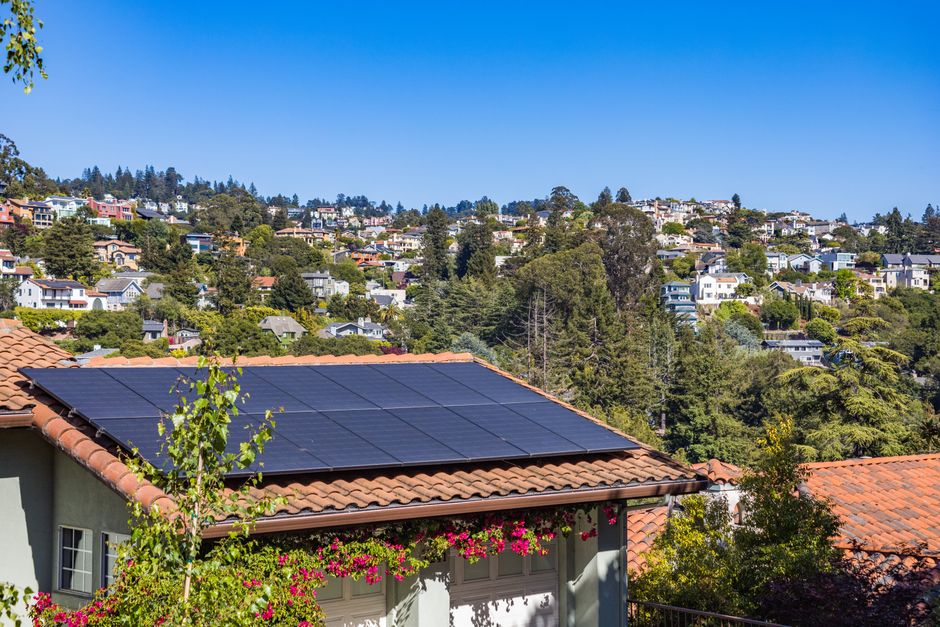
Standard frame-mounted solar panels project above the roof plane by 70 to 150 mm and create a visible profile when viewed from the street or the bay. In-roof integrated solar — where the panels replace the roof covering and sit flush with the surrounding tiles — satisfies the visual-impact test in almost every case. The panels are indistinguishable from standard dark slates from any meaningful viewing distance.
FLD specifies in-roof integrated systems as the default for all Mumbles and West Cross domestic and commercial installations. We do not offer frame-mounted as a cost-saving alternative here because the planning risk is real and the refusal cost — surveyor fees, appeal process, potential enforcement notice — is far higher than the specification premium.
Mumbles Mile and the hospitality commercial market
The Mumbles Mile seafront strip from the Pier to Knab Rock carries a concentration of restaurants, cafes, hotel operations and independent retail that is dense relative to the area’s population. These businesses share a demand profile that is particularly well-suited to solar: high summer footfall driving catering, refrigeration, HVAC and outdoor terrace lighting demand precisely when solar generation peaks.
For a 30 kWp in-roof installation on a Mumbles Mile restaurant or hotel building at 955 kWh/kWp yield, annual generation is 28,650 kWh. With 78% summer-peaked self-consumption at 27p/kWh blended, year-one benefit is approximately £6,800 on £32,000 capex for an in-roof installation. Simple payback 4.7 years, post-tax payback 3.5 years under Annual Investment Allowance.
The in-roof premium — typically 15 to 20% above frame-mounted — is largely recovered through the certainty of planning approval. A frame-mounted refusal on a conservation-adjacent building resets the project timeline by 12 to 18 months. For most Mumbles hospitality operators who want solar generating income in the coming summer season, in-roof is simply the correct choice.
Oyster Wharf and the marina commercial strip
The Oyster Wharf development at the Mumbles Pier end of the promenade brings a modern commercial and residential mix that has different planning characteristics from the older seafront buildings. Marina-side commercial units with flat or shallow-pitch roofs are generally not visible from sensitive vantage points within the AONB, which can make standard frame-mounted or flat-roof ballast systems appropriate on a case-by-case basis.
We conduct a pre-application planning check on every Mumbles commercial enquiry before committing to a specification. For Oyster Wharf and the newer marina-adjacent stock, the check typically returns within five working days and confirms whether in-roof or standard specification applies.
Domestic solar across SA3
The housing stock in SA3 is notably varied. Large Edwardian villas line Mumbles Road from Oystermouth up to West Cross, with generous south-facing roof areas and good structural loading capacity. Post-war bungalows dominate Newton and interior West Cross — these are often ideal solar properties because the shallow pitch and large uninterrupted roof area maximises array size without shading complications.
For domestic installations across SA3, SolarEdge panel-level optimisation is our default specification regardless of property type. Coastal tree cover at the AONB boundary and neighbouring roof shading on the tighter village streets mean that string-inverter performance is often compromised in ways that are not obvious at survey stage. SolarEdge optimisers eliminate the weak-link problem and ensure each panel operates independently.
A typical 4 kWp SA3 domestic installation generates 3,820 kWh annually at 955 kWh/kWp. At 44% self-consumption for a household with flexible daytime use at 28p/kWh, plus 12p SEG export on the remainder, year-one benefit is approximately £700. Adding a 5 kWh battery raises effective self-consumption to 64%, increasing year-one benefit to approximately £940.
Gower tourism and the broader SA3 catchment
The SA3 postcode extends well beyond Mumbles to cover the Gower Peninsula proper — Port Eynon, Rhossili, Llangennith and the interior. Farm diversification into glamping, holiday lets and agri-tourism creates a pipeline of 5 kWp to 15 kWp domestic and small commercial installations across the peninsula. These rural properties typically have excellent solar exposure, unconstrained by neighbouring structures, and the Gower soil conditions are suitable for ground-mounted arrays adjacent to farm buildings where roof condition is poor.
For Gower Peninsula farm and rural hospitality enquiries, we follow the same in-roof default given the AONB coverage, but ground-mount suitability is assessed on a case-by-case basis where land is available.
Getting a Mumbles solar quote
FLD is 15 minutes from Mumbles by road from our Swansea base. We survey Mumbles and West Cross regularly, often combining visits with Sketty, Langland and the Gower Peninsula in the same day. Our planning familiarity with AONB-adjacent applications means we can give an accurate in-roof specification and planning risk assessment at the initial survey stage rather than after a failed standard application. Call Paul on 07913 117746 or use the contact page.