Wales has over 500 designated conservation areas — from Tenby’s walled town and Abergavenny’s market centre to the Victorian terraces of Swansea’s Uplands and the slate villages of north Pembrokeshire. Within these designations, the general permitted development rights that allow most rooftop solar installations without planning permission are modified. Understanding what you can and cannot do without consent is essential before commissioning a survey.
What is a conservation area?
A conservation area is an area of special architectural or historic interest, designated by the local planning authority under the Planning (Listed Buildings and Conservation Areas) Act 1990. The designation does not mean no development is permitted — it means that the character and appearance of the area must be preserved or enhanced by any development that takes place.
In Wales, conservation area designations are made by the 22 local planning authorities. Local planning authorities are required to review their conservation area designations from time to time and may extend, modify or de-designate areas.
Permitted development rights for solar in conservation areas
Under the Town and Country Planning (General Permitted Development) Order 1995 and its Welsh amendments, solar panels on a dwelling house are generally permitted development — but with specific conditions that are more restrictive in conservation areas.
Outside conservation areas, the permitted development rules for solar panels on a dwelling house broadly allow:
- Panels not exceeding 200mm projection above the roof plane on a pitched roof
- Panels at or lower than the ridge line
- Panels not on the principal or side elevation fronting a highway
Inside a conservation area, the same rights apply with one critical additional restriction: solar panels on the principal elevation (the front of the house) or on a side elevation visible from a highway require planning permission. This is the key distinction that catches most homeowners in conservation areas.
The practical effect: south-facing rear roof slopes can typically proceed under permitted development in a conservation area. Front roof slopes visible from the street require a planning application.
Listed buildings: a separate consent regime
A listed building has additional controls regardless of whether it is in a conservation area. Listed building consent is required for any works that affect the character of a listed building — and solar panels almost always require listed building consent on a listed property.
The listed building consent application is separate from any planning application. It is assessed by the local planning authority’s conservation officer and must demonstrate that:
- The installation does not harm the special interest of the listed building
- The installation is reversible
- The design minimises visual impact
In-roof integrated solar systems — which replace roof tiles or slates with purpose-designed solar tiles or framed panels sitting flush with the roof plane — are significantly more likely to gain listed building consent than conventional on-roof framed installations standing proud of the original roof surface.
In-roof versus on-roof: the conservation decision
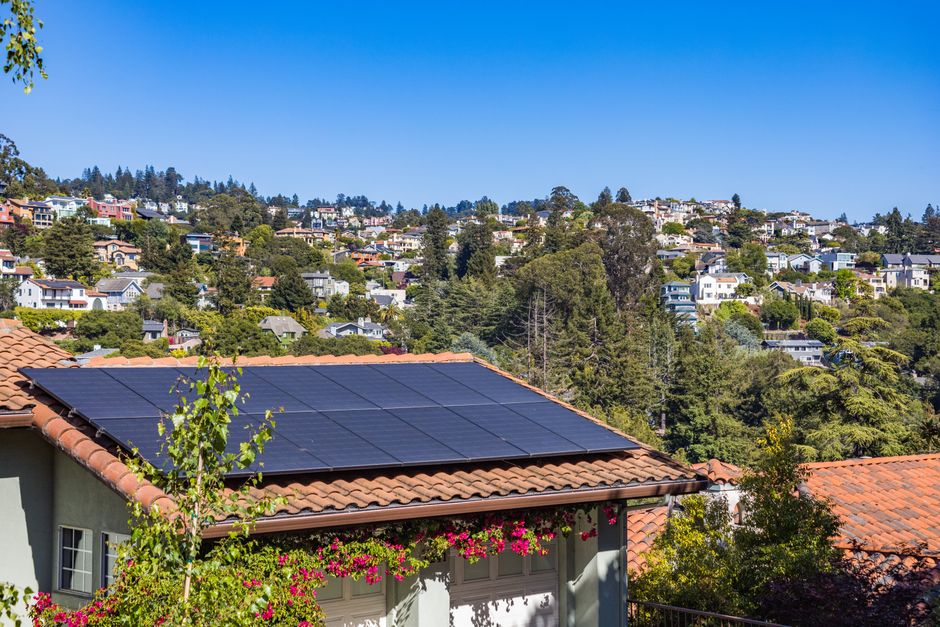
On-roof framed solar: Panels mounted on an aluminium rail system above the existing roof covering. This is the most common residential solar installation type. Panels sit 100mm to 200mm above the roof surface. In conservation areas on rear elevations, this is usually acceptable under permitted development if the conditions above are met.
In-roof integrated solar: Panels replace the roof covering — either full solar tiles (SolarRoofing) or in-roof framed panels that sit flush with the surrounding tile plane. These systems are more expensive (typically 30% to 50% above equivalent on-roof capacity) and require a qualified roofer as well as a solar installer. They are the standard FLD specification for conservation area front elevations and listed buildings where planning or listed building consent is required.
FLD specifies in-roof solar as the default for:
- Any property in a conservation area with a south-facing front elevation
- Any listed building
- Any property in the Gower AONB, Pembrokeshire Coast National Park or Bannau Brycheiniog National Park where the planning authority’s design guidance suggests flush integration
Pre-application consultation
For any conservation area or listed building proposal where the planning status is unclear, FLD recommends a pre-application consultation with the local planning authority before committing to a survey and specification. Most Welsh local planning authorities offer pre-application advice services, typically with a 4 to 6 week response time.
FLD provides pre-application feasibility documentation as part of the initial enquiry process for conservation area and listed building clients, at no additional cost. This includes:
- A site-specific confirmation of conservation area or listed building status
- An assessment of which permitted development rights apply to the specific property and elevation
- A draft design and location description suitable for a pre-application enquiry
Conservation area solar in practice
FLD has installed solar on properties in the Tenby conservation area, the Swansea Uplands conservation area, the Abergavenny conservation area and multiple Pembrokeshire village conservation areas. In each case the pre-application consultation with the conservation officer was completed before the survey was booked, and in every case FLD specified in-roof integrated panels on visible elevations.
Call Paul on 07913 117746 to discuss your conservation area property and confirm the planning position before booking a survey.