Bannau Brycheiniog National Park — redesignated from Brecon Beacons National Park in 2023 — covers 1,347 square kilometres of upland Wales, including significant areas of Powys, Carmarthenshire and Monmouthshire. Within the National Park boundary, planning controls for solar installations are more stringent than in the surrounding countryside, and the National Park Authority’s planning policies add requirements beyond the standard Welsh permitted development rules. Understanding what is and is not permitted before commissioning a survey is essential for any property within or adjacent to the park boundary.
How the National Park boundary affects planning rights
Bannau Brycheiniog National Park Authority (BBNPA) is itself the local planning authority within the park boundary — not Powys, Carmarthenshire or Monmouthshire councils. All planning applications for properties within the park are determined by BBNPA, and the National Park Authority’s Local Development Plan sets the policy framework.
Within the National Park, the fundamental objective of planning policy is the conservation and enhancement of the park’s natural beauty, wildlife and cultural heritage. This applies to solar installations as to any other development.
Permitted development rights for residential solar in the National Park
The Town and Country Planning (General Permitted Development) Order 1995 and its Welsh amendments apply within national parks, but with additional restrictions compared to standard rural areas.
For dwelling houses in Bannau Brycheiniog:
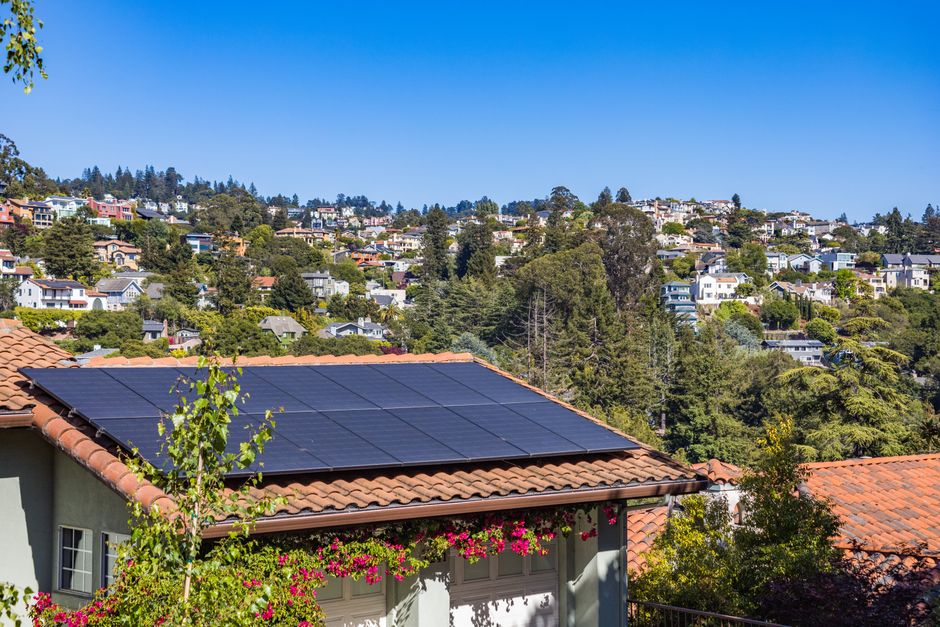
Solar panels on a dwelling house are permitted development within the National Park subject to conditions, but with one critical restriction that applies in national parks (as in conservation areas and Areas of Outstanding Natural Beauty): solar panels on the principal elevation (the front of the house facing a road or public area) are not permitted development and require a planning application.
The conditions for permitted development on non-principal elevations are:
- Panels must not protrude more than 200mm above the roof plane on a pitched roof
- Panels must be at or below the ridgeline
- The installation must be removed when no longer needed
- The surface of the panels must, so far as practicable, be sited to minimise the effect on the amenity of the area
This last condition — minimising effect on amenity — is interpreted by BBNPA planning officers with reference to the National Park’s landscape character. Highly reflective panel surfaces on properties visible from key viewpoints can raise objections even on rear elevations.
Agricultural solar in the National Park
Agricultural buildings in Bannau Brycheiniog are a common enquiry for FLD. The permitted development rules for agricultural solar under Schedule 2, Part 6 of the GPDO apply within the National Park, but the prior approval process for agricultural solar above certain thresholds gives BBNPA the opportunity to assess design and siting.
For agricultural solar installations:
- Installations on agricultural buildings (rooftop) under 1 MWp are generally permitted development subject to prior approval
- Ground-mounted solar on agricultural land within the National Park is subject to much tighter controls and routinely requires full planning permission regardless of size
- BBNPA has refused ground-mounted agricultural solar on visual amenity grounds on open upland sites — the standard approach of mounting panels in open fields that would be acceptable outside the park is typically not acceptable within it
For agricultural clients within the park boundary, FLD’s recommended approach is rooftop solar on existing farm buildings — barns, machinery stores, cattle sheds — rather than ground-mounted arrays. Rooftop agricultural solar is significantly more likely to achieve consent than ground-mounted schemes.
Design standards BBNPA applies to planning applications
Where a planning application is required for solar in the National Park, BBNPA design guidance specifies:
In-roof integration is preferred over on-roof mounting: Panels that sit flush with the roof plane are significantly favoured over raised rail systems. For slate roofs (common in the park’s slate quarrying communities), BBNPA often requires panels that match the colour and texture of the original Welsh slate.
Siting to minimise landscape impact: Applications must include a landscape and visual impact assessment for any installation visible from public rights of way, open access land, or key viewpoints identified in the BBNPA Landscape Character Assessment.
South and east facing rear slopes preferred: Applications for south-facing rear slopes away from public vantage points are treated considerably more favourably than front or side elevation proposals.
Pre-application consultation with BBNPA
BBNPA offers a pre-application advice service for solar proposals within the park. FLD recommends pre-application consultation in all cases where:
- The property is within the National Park boundary
- The installation involves any elevation visible from a public road, footpath or viewpoint
- The installation is agricultural and above domestic scale
BBNPA’s pre-application response times are typically 4 to 8 weeks. FLD prepares pre-application enquiry documentation as part of the initial feasibility stage, at no additional cost to the client. This includes a site-specific design rationale addressing the National Park’s policy objectives.
Properties on or near the park boundary
The National Park boundary is not always obvious from the postal address or postcode. Some properties in LD, NP and SA postcodes that appear to be outside the park are within it, and some that appear to be inside it are not. FLD verifies the National Park status of every property as part of the initial enquiry process using BBNPA’s GIS boundary data.
Call Paul on 07913 117746 to discuss a property within or near Bannau Brycheiniog National Park.