Most commercial solar installations in Wales do not require a full planning application. Schedule 2, Part 40 of the Town and Country Planning (General Permitted Development) Order 1995 (as amended for Wales) grants permitted development rights for solar equipment on commercial, industrial and agricultural buildings — subject to conditions and, for larger installations, a prior approval process. Understanding these rules correctly can save a commercial project 12 to 20 weeks of planning lead time and several thousand pounds in application fees.
What Schedule 2, Part 40 permits on commercial buildings
Part 40 of the GPDO grants permitted development rights for the installation of solar photovoltaic or solar thermal equipment on the roof or wall of a commercial building. The key permitted development conditions for commercial rooftop solar are:
Size and projection:
- Solar panels must not project more than 200mm beyond the roof plane on a pitched roof
- On a flat roof, panels may be installed at an angle, but the highest point of the installation must not exceed the height of the roof by more than 1 metre
- The installation must not be on a listed building
Appearance:
- The panels must, so far as practicable, be sited to minimise the effect on the external appearance of the building and the amenity of the area
Removal:
- The equipment must be removed when it is no longer required and the roof made good
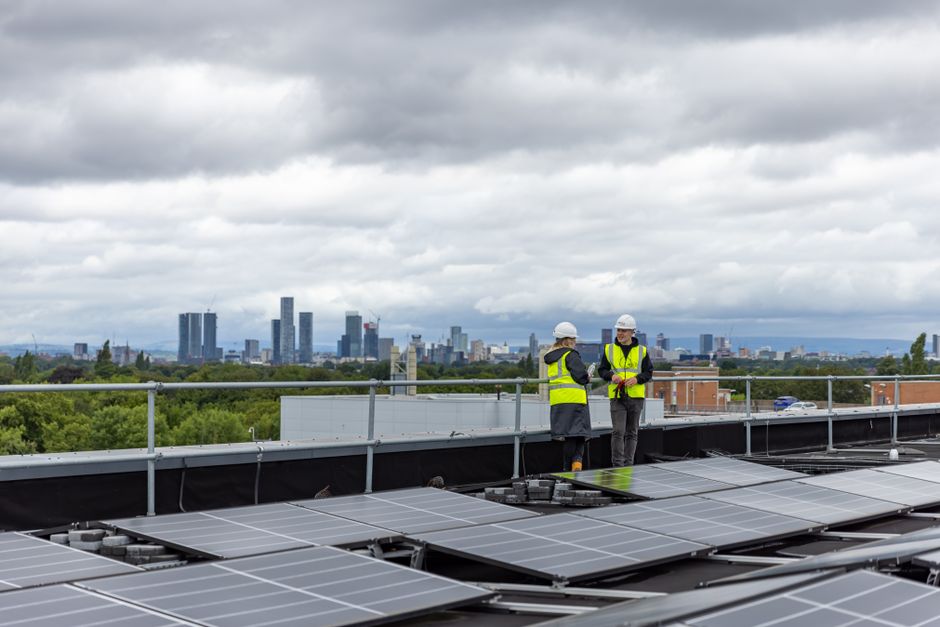
For most commercial and industrial buildings with flat roofs — the standard for modern warehouses, factories, distribution centres and large retail units — these conditions are straightforward to satisfy. Panels on a flat roof at a low tilt angle (5 to 15 degrees) typically remain well within the 1 metre height restriction.
Prior approval: when it applies and what it covers
For commercial solar installations above certain capacity thresholds, permitted development is subject to prior approval rather than simply proceeding without notification. Prior approval allows the planning authority to assess specific aspects of the proposal — principally siting and design — before work starts, but is not a full planning application.
Prior approval is required for commercial solar installations where the generating capacity exceeds 1 MWp on a single building. For most commercial rooftop installations below 1 MWp, prior approval is not required and the installation can proceed under the general permitted development conditions above.
The prior approval process requires:
- Written notification to the local planning authority before work starts
- Details of siting and design of the equipment
- A period of 28 days for the authority to determine whether prior approval is required
In practice, the vast majority of commercial rooftop solar installations in South Wales are below 1 MWp and proceed without any planning notification. A 500kWp installation on a large logistics shed — covering approximately 2,500 square metres of roof at 200W/m² module density — falls well within the permitted development threshold.
Agricultural buildings: Schedule 2, Part 6
Solar equipment on agricultural buildings follows a different part of the GPDO — Schedule 2, Part 6 — rather than Part 40. The key distinction is that Part 6 applies to agricultural buildings and land within an agricultural unit of 0.4 hectares or more.
For agricultural solar on existing farm buildings:
- Installations on existing buildings are generally permitted development subject to prior approval for installations above a specified capacity
- The prior approval process for agricultural solar considers siting, design and transport impacts
- Permitted development rights do not apply to listed buildings or within National Parks, conservation areas or AONBs without modification
For ground-mounted solar on agricultural land, Part 6 provides limited permitted development rights and most significant agricultural ground-mount schemes require full planning permission.
When full planning permission is required for commercial solar
Full planning permission is required for commercial solar in the following circumstances:
Listed buildings: Any solar installation on a listed building requires listed building consent. Permitted development rights under Part 40 do not apply. Listed building consent applications are assessed by the council’s conservation team against criteria focused on reversibility, visual impact and protection of the building’s special character.
Conservation areas — certain elevations: Commercial buildings within conservation areas require planning permission for solar on principal elevations visible from a highway, as in the residential context.
National Parks and AONBs: Within Bannau Brycheiniog National Park, the Pembrokeshire Coast National Park and the Gower AONB, permitted development rights are more restricted and the relevant planning authority should be consulted before proceeding.
Ground-mounted commercial solar above 1 MWp: Large ground-mounted commercial solar (solar farms) requires full planning permission regardless of location. In Wales, applications above 350 MW fall under the jurisdiction of the Welsh Ministers (Development of National Significance process) rather than the local planning authority.
Extensions to existing permitted development installations: Adding capacity to an existing installation that was itself approved as permitted development may require prior approval or full planning permission depending on the combined capacity.
Confirming permitted development status before your survey
FLD confirms the permitted development status of every commercial solar project as part of the initial feasibility assessment. For straightforward flat-roof commercial buildings outside designated areas, this confirmation is typically immediate. For listed buildings, conservation area properties, or buildings within or adjacent to National Parks or AONBs, FLD provides a written planning position statement before committing to a survey and specification.
Call Paul on 07913 117746 to discuss the planning position for your commercial property.