Dolgellau is built almost entirely from local dark grey dolerite — a stone that gives the town one of the most atmospherically distinctive townscapes in Wales. The dark walls, the narrow streets running between the castle rock and the Mawddach, the shadow of Cadair Idris directly to the south: Dolgellau looks unlike any other Welsh town, and that visual character defines the solar specification challenge here.
Standard silver-framed solar panels with white polyester backsheets read as visually alien on Dolgellau’s dark roofscapes. The contrast between pale aluminium rails and dark slate is sharp enough to trigger ENPA objection on grounds of visual impact. The solution is not complicated: dark-frame, black-monocrystalline panels with black backsheet, installed in-roof integrated where consent is required. Dark panels on dark roofs are nearly invisible from the street-level viewpoints that ENPA assesses.
Eryri National Park: the planning position
Eryri National Park Authority processes solar planning applications under the same GPDO framework as any other planning authority in Wales. Permitted development rights apply within the Park in the same way as in a conservation area — which means:
- Rear-slope solar, not visible from a highway: permitted development, no ENPA consent needed
- Front-elevation solar visible from a highway: planning application required
- Listed buildings: listed building consent required, Cadw consultation
- Commercial systems above 50 kWp: full planning consent with Design and Access Statement
ENPA’s published 2024 guidance takes an actively supportive position on solar as a climate response measure. Pre-application consultation is recommended for any proposal that requires consent; ENPA planning officers respond within 4 to 6 weeks and provide clear guidance on specification before a formal application is submitted.
The in-roof integrated specification
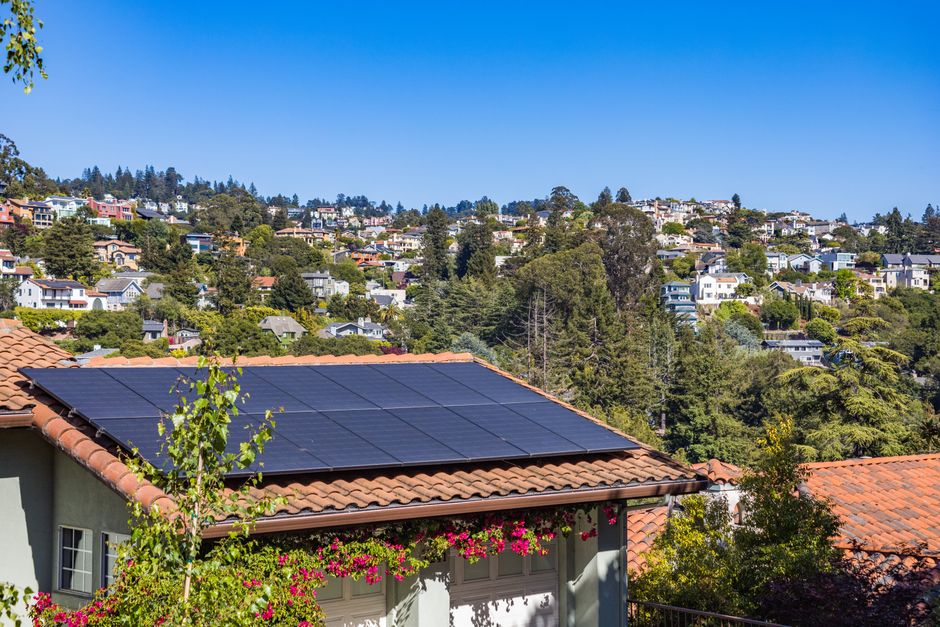
In-roof integrated solar modules replace a section of the existing roof covering. The panel sits within the roof plane flush with the surrounding tiles or slates, with no protruding frame above the roof surface. The visual profile from street level is close to a solid dark roof section — far less visually intrusive than the rail-and-panel assembly of a standard on-roof system.
For Dolgellau, FLD specifies:
- Dark grey or black aluminium frame
- Black monocrystalline cells (SunPower Maxeon or equivalent full-black)
- Black backsheet
- In-roof mounting system with continuous under-membrane waterproofing
The cost premium over equivalent on-roof capacity is approximately 35 to 45%. For a 4 kWp domestic installation in Dolgellau’s conservation area, the premium adds approximately £1,200 to £1,800 to the total. For a 20 kWp guesthouse system requiring ENPA planning consent, the premium is approximately £3,500 to £5,000 — well worth paying to secure approval and deliver an installation that enhances rather than detracts from the property’s appearance.
Barmouth: inside the Park but rear-slope first
Barmouth (LL42), 15 miles south-west of Dolgellau on the Mawddach estuary, sits inside Eryri but has a different streetscape geometry. The town clings to a steep hillside above the beach, and many residential properties have south-west-facing rear pitches invisible from the seafront promenade and the main A496 road. These rear pitches proceed under permitted development.
For holiday-let properties on Barmouth’s hillside — where the installation is typically on a rear slope facing Cardigan Bay across the roof ridge — the standard on-roof system is often acceptable under permitted development even inside the Park. FLD confirms the viewpoint position at initial survey.
Harlech: World Heritage Buffer Zone
Harlech (LL46) adds a further planning layer: the UNESCO World Heritage Buffer Zone around Harlech Castle. Properties within the Buffer Zone require consultation with both ENPA and Cadw before any solar application. Outside the Buffer Zone but inside the Park, standard ENPA pre-application consultation applies.
FLD checks World Heritage Buffer Zone position at initial enquiry for all Harlech properties. The Buffer Zone covers the immediate castle precinct and the cliff-top historic core. Most residential properties on the residential streets and holiday-let areas north and south of the castle core are outside the Buffer Zone boundary.
Tywyn: the same yield, without the Park overlay
Tywyn (LL36) sits on the same coastline as Barmouth and Harlech, achieves the same 970 kWh/kWp yield, and has comparable holiday-let and guesthouse stock — but it is outside the Eryri National Park boundary. Standard Welsh permitted development applies. A rear-slope installation at Tywyn is completed in 4 to 6 weeks from survey; the equivalent Barmouth installation requiring pre-application consultation takes 10 to 14 weeks.
Getting a Gwynedd coastal solar survey
FLD covers LL36, LL40, LL42 and LL46 on a Meirionnydd coastal circuit combining with Machynlleth. Drive time from Swansea is 120 to 145 minutes depending on the specific location. Call Paul on 07913 117746 to discuss a Dolgellau, Barmouth, Harlech or Tywyn solar installation.