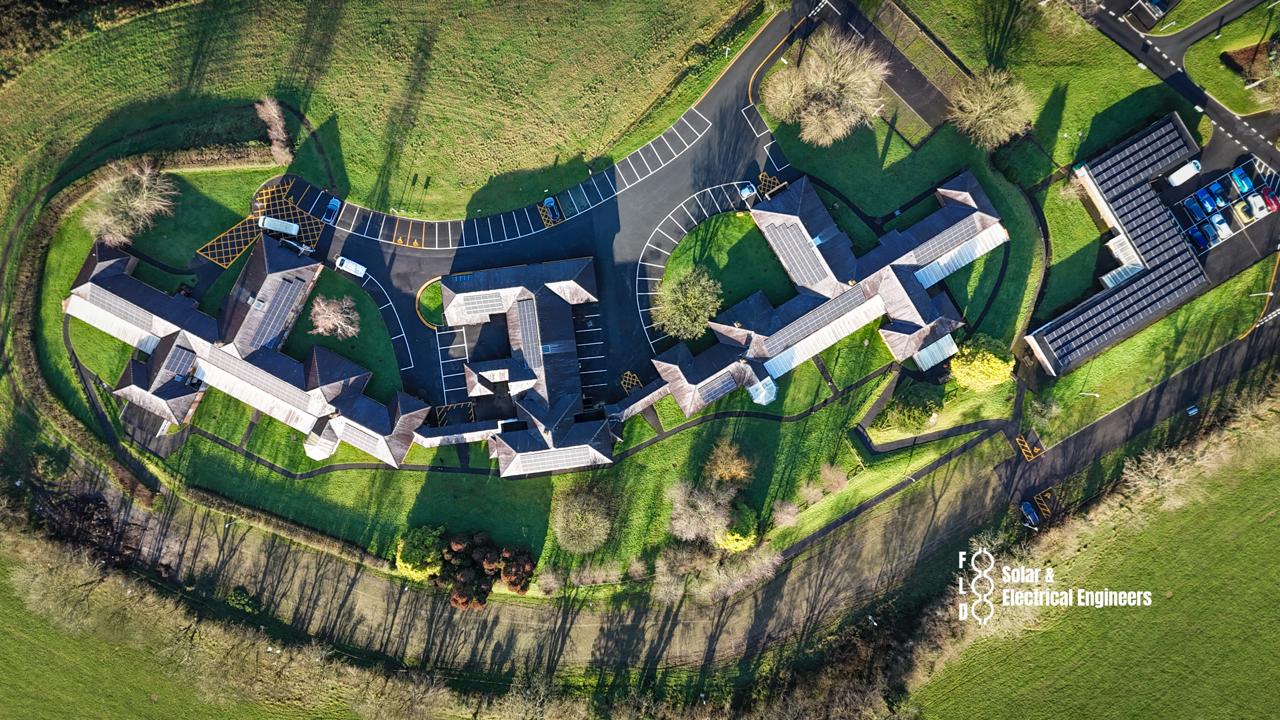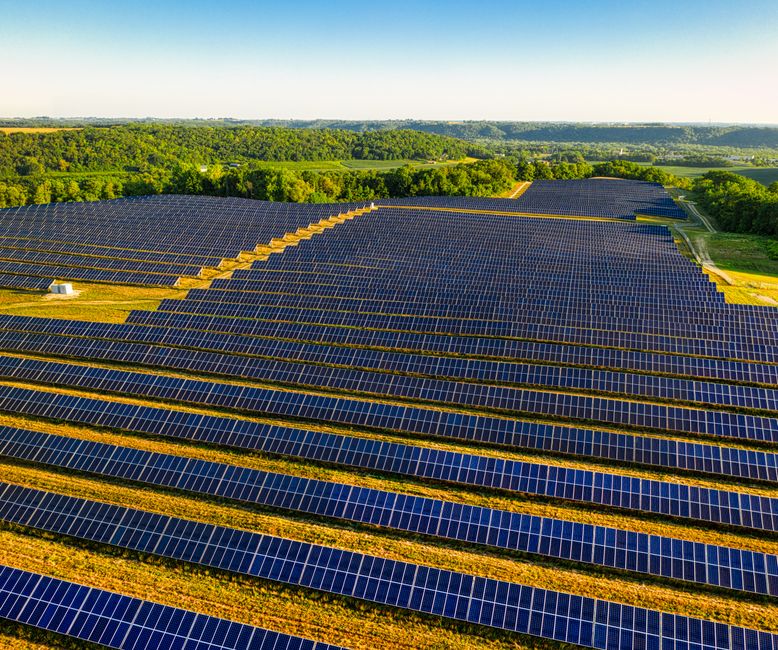
South Wales has one of the highest concentrations of distribution warehouse stock in the UK outside the East Midlands logistics triangle. The M4 corridor from Newport to Swansea carries major 3PL sheds operated by DHL, Amazon, ASDA, Wincanton and XPO, with secondary clusters at Bridgend CF31, Llantrisant CF72 and the Swansea Distribution Park SA6. These buildings share a common solar characteristic: large, flat-to-low-pitch roof areas with minimal shading — ideal for dense panel arrays generating high absolute output.
Why warehouses are the strongest commercial solar business case
Warehousing combines high roof-to-floor ratios with continuous electricity demand from lighting, refrigeration, conveyor systems and charging banks for electric forklifts and pallet movers. A modern 10,000 m2 ambient distribution shed typically carries 5,000 to 7,000 m2 of usable south-facing roof — enough for 500 kWp to 700 kWp of panels. Multi-shift and 24/7 operations achieve self-consumption rates of 75% to 85%, absorbing the majority of generation directly at the site.
Payback models: 300 kWp and 750 kWp
300 kWp, 75% self-consumption (single-shift M4 corridor shed):
| Metric | Value |
|---|---|
| Annual generation | 285,000 kWh |
| Self-consumed (75%) | 213,750 kWh |
| Electricity cost saving | £57,713 |
| SEG export income (25%) | £8,550 |
| Year-one benefit | £66,263 |
| Installed cost | £258,000 |
| Simple payback | 3.9 years |
| AIA post-tax payback | 2.9 years |
750 kWp, 82% self-consumption (24/7 refrigerated logistics shed):
| Metric | Value |
|---|---|
| Annual generation | 712,500 kWh |
| Self-consumed (82%) | 584,250 kWh |
| Electricity cost saving | £157,748 |
| SEG export income (18%) | £15,390 |
| Year-one benefit | £173,138 |
| Installed cost | £615,000 |
| Simple payback | 3.6 years |
| AIA post-tax payback | 2.6 years |
Annual Investment Allowance allows 100% of capital cost to be deducted against taxable profit in year one. For a 750 kWp system at £615,000, the AIA Corporation Tax credit at 25% is approximately £153,750 — reducing effective capex to approximately £461,250 and pulling payback from 3.6 to 2.6 years.
Electric forklift charging: the self-consumption multiplier
The single most important development in warehouse solar economics in 2025 to 2026 has been the accelerating transition from LPG to electric forklift fleets. A typical 10,000 m2 distribution shed operating 8 to 12 electric forklifts consumes 200 to 350 kWh daily on charging alone. Scheduling charging banks to run during solar hours — typically 09:00 to 15:00 — dramatically improves self-consumption rates and reduces the volume of generation exported at the lower SEG rate.
FLD programmes SolarEdge energy management systems to prioritise forklift charging during peak generation periods. For sheds transitioning from LPG fleets, the combined saving from avoided LPG costs and reduced grid electricity more than justifies the investment case.
Roof structure considerations for warehouse solar
Steel portal frame warehouse roofs carry solar panels well, but the structural assessment must confirm purlins can accommodate the additional dead load — typically 15 to 20 kg/m2 for a framed panel-and-rail installation. FLD works with structural engineers to provide roof load calculations as part of the feasibility report. Composite cladding panels — common on sheds built after 2000 — are typically straightforward. Older fibre-cement or asbestos-containing cladding requires specialist removal before solar installation can proceed.
All warehouse installations above 50 kWp require G99 DNO approval. In the M4 corridor, the relevant DNO is NGED for sites east of the Loughor estuary and SP Manweb for the Carmarthenshire catchment. G99 Type A approval timelines in 2026 run at 10 to 14 weeks for NGED and 14 to 20 weeks for SP Manweb. FLD submits DNO pre-application enquiries before committing to project programmes to manage scheduling risk.
Ynni Cymru and Salix funding for qualifying warehouses
Warehouses operated by registered social landlords, NHS supply chain operators or publicly-contracted logistics businesses may qualify for Salix Wales interest-free financing. Commercial operators in the private sector can apply to Ynni Cymru for capital grants of £25,000 to £1,000,000. FLD assists with Ynni Cymru pre-application feasibility reports, which the programme requires before formal applications are assessed.
Getting a warehouse solar survey
FLD has surveyed and installed at distribution sheds across the M4 corridor from Newport to Swansea, the Swansea Distribution Park SA6, Baglan Energy Park SA12, and the Bridgend Industrial Estate CF31. Call Paul on 07913 117746 or use the contact page for a no-cost preliminary roof survey and feasibility assessment.