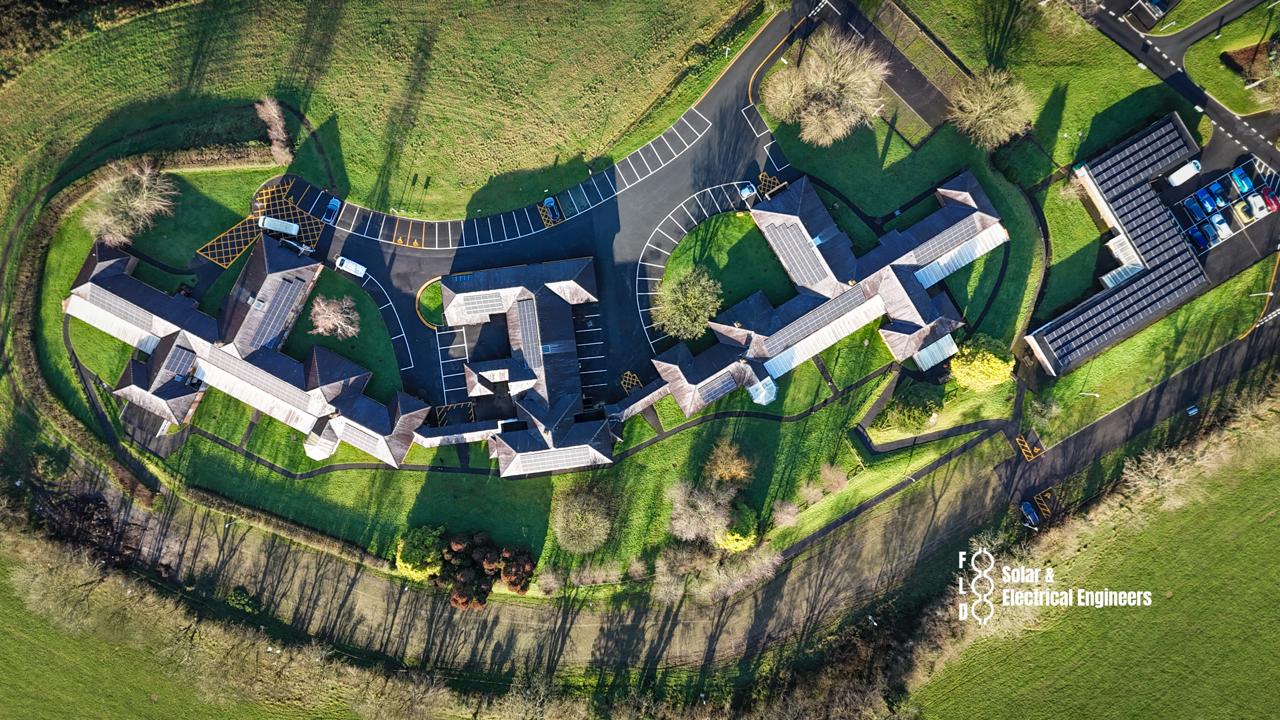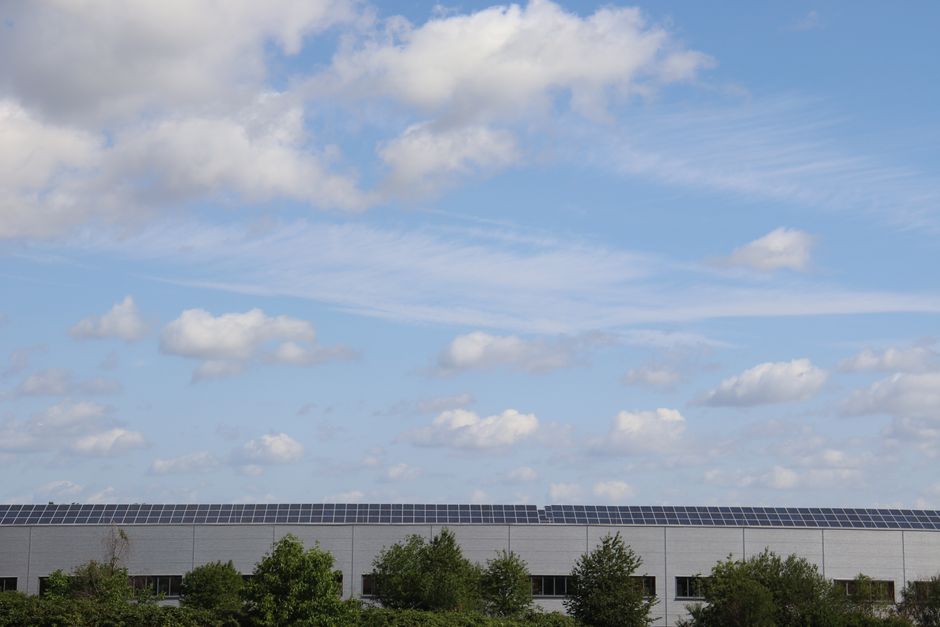
Chepstow’s position at the M48 crossing makes it the commercial gateway between England and South Wales. That gateway function has given the town a logistics and manufacturing presence — Bulwark Industrial Estate and Chepstow Industrial Estate — that is disproportionate to the residential population of 14,000. For a commercial solar installer, Chepstow’s industrial estates represent a cluster of flat-roof and portal-frame buildings with consistent south-facing orientation and straightforward NGED G99 connection access.
Bulwark Industrial Estate
Bulwark Industrial Estate at NP16 5UH carries light manufacturing, precision engineering, trade-counter and logistics tenants across a range of building types constructed from the 1970s through 1990s. The construction era means flat-roof and low-pitch portal-frame buildings dominate — the standard commercial solar form factors.
A 150 kWp ballasted flat-roof installation at Bulwark at 955 kWh/kWp yield generates 143,250 kWh annually. For a two-shift manufacturing or engineering business with 70% self-consumption at 27p/kWh blended, first-year saving reaches approximately £32,000 on £130,000 installed cost. Simple payback 4.1 years; post-AIA payback 3.0 years.
The NP16 postcode falls within the NGED distribution area. G99 Type A applications for Bulwark and Chepstow Industrial have been running at 10 to 14 weeks in 2025 to 2026 — broadly consistent with the NGED South Wales average. FLD manages the G99 application pack from the design stage.
Chepstow Racecourse solar opportunity
Chepstow Racecourse is among the most energy-intensive commercial facilities in Monmouthshire. Floodlighting for evening jump meetings (Welsh Grand National, Coral Trophy), hospitality buildings, stabling, car parks and catering all generate substantial electricity demand concentrated in the autumn-to-spring jump season.
The solar case here is unusual because the demand peak is partly winter-weighted, which reduces the summer-bias advantage of solar. The mitigation is twofold: a battery system captures surplus summer generation and uses it to offset autumn and winter grid import; and the racecourse hospitality and daytime operations year-round (conferences, weddings, private events) provide a solar-aligned daytime demand base. A 200 kWp rooftop installation on the grandstand buildings generating 191,000 kWh annually with a 200 kWh battery stack is the starting point FLD would model for a racecourse site survey.
Wye Valley AONB: what it means for Chepstow commercial and domestic
The Wye Valley AONB eastern boundary follows the river line immediately east of Chepstow. Commercial buildings on the industrial estates to the west of town sit outside the AONB visibility catchment for most standard solar installation configurations. Domestic properties on the valley-facing eastern slope of the town — particularly in the Hardwick and St Kingsmark areas — may fall within viewpoint sensitivity zones defined in the AONB management plan.
FLD’s pre-survey AONB position check for Chepstow confirms whether a proposed installation is within a key viewpoint catchment. For the great majority of domestic and commercial installations west of the A48, the AONB constraint does not apply. Where it does, the same in-roof integrated specification and pre-application consultation approach we use for Monmouth and Usk applies here.
Domestic solar in NP16
Chepstow’s housing mix spans the medieval and Georgian town centre through extensive post-war estate development at Bulwark and Thornwell. The Bulwark estate, built largely in the 1970s and 1980s, carries the low-pitch south-facing rooftops that are less solar-optimal than the steeper Victorian pitch. However, many Bulwark properties have been extended or reroofed, and modern solar panel efficiency (22 to 24% cell efficiency on current SolarEdge-optimised Trina Vertex panels) compensates substantially for sub-optimal pitch angles.
At 955 kWh/kWp, a 4 kWp domestic system on a standard Bulwark semi-detached generates approximately 3,820 kWh annually. With battery storage and time-of-use tariff optimisation, annual electricity cost for a typical household falls to under £200. Payback on the combined system: 9 to 11 years.
Getting a Chepstow commercial solar assessment
FLD covers NP16 via the M4 and A48 in approximately 90 minutes from Swansea. Chepstow combines with Monmouth and Newport into a single eastern corridor commercial survey day. Call Paul on 07913 117746 to discuss a Chepstow industrial estate or domestic solar assessment.