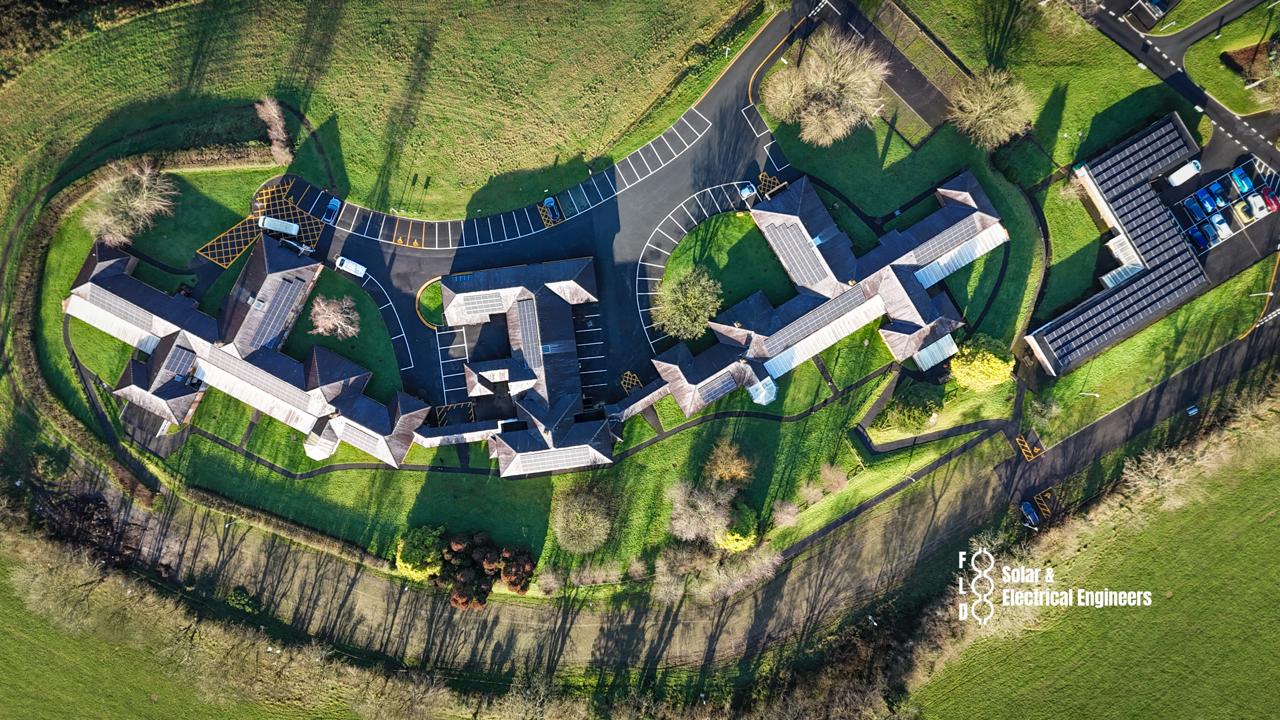
Carmarthen is the county town of Carmarthenshire and the administrative and retail hub for a wide rural hinterland. The SA31 commercial catchment ranges from town-centre retail and professional services through light industrial units at Johnstown and Llangunnor to the substantial agricultural processing and rural enterprise economy that defines the wider county.
Commercial solar in SA31 sits at the intersection of two distinct markets: urban town-centre businesses with modest roof areas but consistent daytime demand, and rural-edge businesses with larger building footprints and above-average electricity costs driven by SP Manweb rural network tariffs.
The Carmarthenshire solar yield advantage
PVGIS data for SA31 returns a baseline of 965 to 975 kWh/kWp — above the Swansea city average of 950 kWh/kWp and well above Cardiff’s 940 to 945 kWh/kWp. The Tywi Valley exposure and Atlantic influences from Carmarthen Bay give the town a solar resource that justifies a slight premium on yield assumptions over the South Wales average in financial models.
On a 100 kWp commercial system, the Carmarthenshire yield premium over a Cardiff installation generates approximately 2,500 kWh of additional annual generation — worth approximately £675 at 27p/kWh self-consumption — compounding over 25 years.
Payback model: 100 kWp SA31 commercial premises
| Metric | Value |
|---|---|
| Annual generation | 97,000 kWh |
| Self-consumed (68%) | 65,960 kWh |
| Electricity cost saving (30p/kWh) | £19,788 |
| SEG export income (32%) | £3,720 |
| Year-one benefit | £23,508 |
| Installed cost | £86,000 |
| Simple payback | 3.7 years |
| AIA post-tax payback | 2.7 years |
SP Manweb and rural connection timelines
Carmarthen is firmly in SP Manweb territory. G99 Type A approval timelines run at 14 to 20 weeks from submission, with rural substation export headroom varying significantly across the SA31 catchment. Substations serving town-centre retail and the Johnstown industrial area carry reasonable export headroom in 2026. Rural edge substations — particularly those serving Llangunnor and the Carmarthen north bypass corridor — require pre-application export capacity checks before FLD commits to project timelines.
FLD runs SP Manweb pre-application enquiries as a standard step before every commercial proposal in SA31. This adds 2 to 3 weeks at the start of the project but eliminates the risk of a late-stage programme delay caused by unexpected export constraint.
Ynni Cymru: the Carmarthenshire case
Carmarthenshire businesses are well-positioned for Ynni Cymru grant applications. The programme is administered by the Welsh Government and explicitly includes rural enterprise, agricultural processing, tourism and professional services businesses — exactly the profile of much of the SA31 commercial economy. FLD has assisted multiple Carmarthenshire clients through the Ynni Cymru pre-application process.
For a 100 kWp installation at £86,000, a Ynni Cymru grant of £15,000 to £25,000 is within published eligibility ranges. Combined with AIA Corporation Tax credit of approximately £21,500, effective capex can be reduced to approximately £39,500 — producing a post-grant, post-tax payback of under 2 years for high-self-consumption sites.
Agricultural processing and food businesses
SA31 hosts a number of agricultural processing businesses — dairy, meat and food production operations with continuous daytime electricity loads well-suited to solar. These businesses typically achieve self-consumption rates of 72% to 80% on well-sited arrays, producing the strongest payback cases in the Carmarthen catchment. Farming Connect capital grants of up to 40% are available for qualifying agricultural business premises, improving payback further.
FLD specifies combined solar and battery storage for agricultural processing sites with significant evening and overnight demand — extending the self-consumption window beyond solar hours.
Domestic solar in SA31
Carmarthen’s residential stock is mixed: pre-war terraces and semi-detached in the town centre, post-war estates across Pensarn and Priory Street, and newer detached stock on the Carmarthen periphery. The Atlantic yield advantage applies equally to domestic installations. A 4 kWp south-facing SA31 domestic installation at 970 kWh/kWp generates 3,880 kWh annually — producing year-one benefit of approximately £780 to £820 depending on household self-consumption.
FLD covers SA31 on regular Carmarthenshire survey days, typically combining Carmarthen town visits with calls at Ammanford, Llanelli and the wider SA31 rural hinterland.
Getting a Carmarthen survey
Call Paul on 07913 117746 or use the contact page to discuss solar options for your SA31 commercial premises or home.