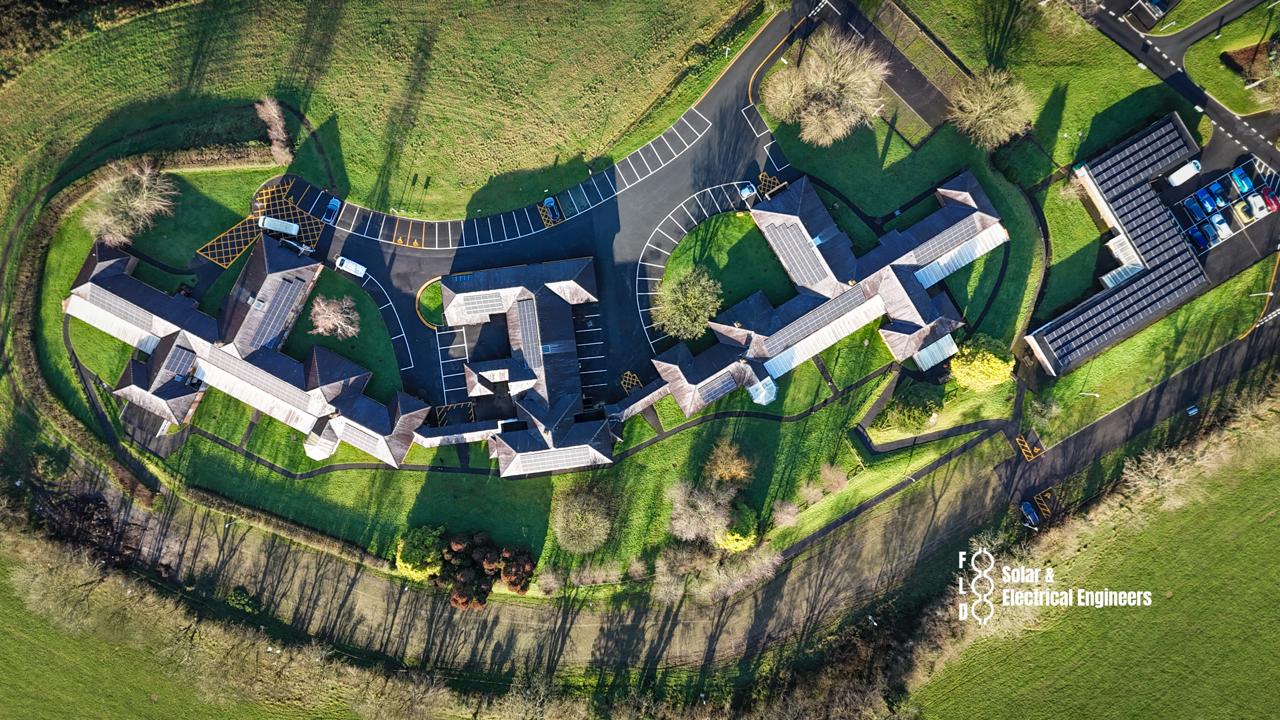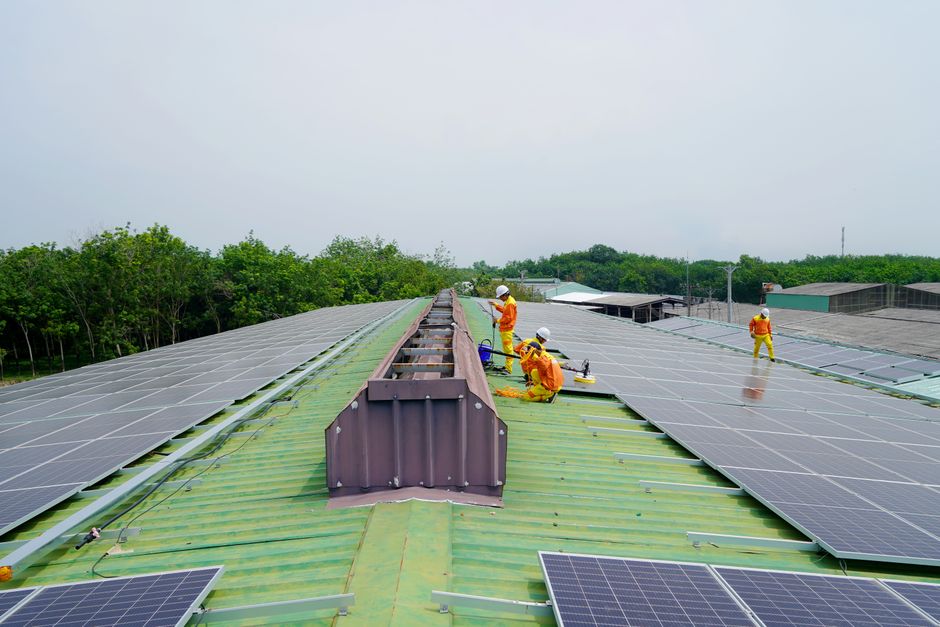
Carmarthen is FLD’s gateway to agricultural solar in west Wales. The county town of Carmarthenshire sits 45 minutes from our Swansea base, and within a 20-mile radius of Carmarthen Castle lie hundreds of Welsh-speaking farm businesses eligible for Farming Connect grants. This guide covers what that opportunity looks like in practice.
The agricultural solar case for Carmarthenshire farms
Dairy, beef, arable and poultry operations in the Tywi and Teifi catchments all have daytime electrical loads that map well to solar output. Dairy farms are the most compelling case. A modern milking parlour running twice-daily, combined with refrigeration for bulk tanks, creates a consumption profile with 70 to 80% daytime load.
A 50 kWp farm system at Carmarthen’s PVGIS yield of 965 kWh/kWp generates 48,250 kWh annually. With 75% self-consumption at 28p/kWh and 25% export at 12p SEG, first-year benefit comes to approximately £11,600. Against installed capex of £43,000 to £47,000, simple payback sits under four years and post-tax payback under three years with Annual Investment Allowance.
For larger holdings with grain-drying, pig or poultry operations, 100 kWp to 150 kWp systems are entirely realistic. A 100 kWp system at the same yield and consumption profile generates first-year benefit near £22,000 on capex of around £85,000.
Farming Connect grants in 2026
Farming Connect is the Welsh Government programme providing business support and capital grants for Welsh farming businesses. Energy efficiency and renewable energy installations are among the eligible expenditure categories. Grant rates vary by scheme round and business type; 25% to 40% grant contribution towards solar capital cost has been available in recent rounds.
The application process requires a business plan and an energy audit. FLD can provide the technical specification and generation model required for the application at no additional cost. The critical timing rule applies here as it does for Ynni Cymru: the grant application must be submitted and an award letter received before procurement begins. Talk to us at the same time as you contact Farming Connect.
Public sector: Carmarthenshire County Council and Hywel Dda
Carmarthenshire County Council at County Hall is a major institutional employer and a potential procurement partner for commercial solar across its estate. Welsh local authorities use the NPS Cymru procurement framework for energy capital works, and FLD’s ConstructionLine accreditation supports that route.
Glangwili Hospital under Hywel Dda University Health Board has a continuous daytime demand profile, making it a natural candidate for rooftop solar. NHS Wales public-sector procurement uses Salix Wales Funding Programme for energy capital works, with interest-free loans repaid from energy savings. FLD has navigated Salix applications before and can support the technical documentation.
University of Wales Trinity Saint David’s Carmarthen campus is a third institutional opportunity. The creative cluster anchored by Yr Egin S4C gives the university an unusually visible decarbonisation platform — a campus solar array alongside the Welsh-language broadcast headquarters is a natural story to tell.
Cross Hands corridor: the industrial extension
While the Carmarthen town focus is agricultural and public-sector, the Cross Hands corridor 12 miles to the south-east adds a significant industrial dimension. Parc Pensarn on the north-east edge of Carmarthen and the Cillefwr Industrial Estate provide local commercial estate, but the real industrial density sits at Cross Hands Business Park where Castell Howell Foods’ well-known 845 kWp installation demonstrates what the catchment can support.
For businesses on the Ammanford and Cross Hands axis, see our separate SA18 commercial solar guide.
Planning and bilingual considerations
Carmarthen falls within Carmarthenshire County Council’s local development plan area. Most commercial rooftop and agricultural solar is permitted development under Welsh PDR. The Carmarthen town centre conservation area imposes restrictions on visible front-elevation solar, but most farm and business park installations are unaffected.
FLD provides bilingual quotations for Carmarthenshire clients where requested. In an area with a Welsh-speaking population significantly above the South Wales average, clear bilingual documentation is both respectful and practically useful when coordinating with staff and contractors.
Solar yield and seasonality in Carmarthen
PVGIS irradiation data for Carmarthen returns 965 kWh/kWp annually, the second highest in FLD’s primary coverage area after Pembrokeshire. The SA31 catchment benefits from its position west of the main South Wales valley shadow, with coastal influence from the Tywi Estuary contributing additional irradiation in the spring and summer months.
Seasonal distribution is pronounced: July and August together account for around 30% of annual yield, which suits summer-peak agricultural operations (silage, grain harvest, irrigation pumping) particularly well.
Getting a Carmarthen solar quote
FLD visits Carmarthen regularly for agricultural surveys. Same-week survey availability is standard for farm clients in the SA31 catchment. For bilingual enquiries, Welsh-language initial communication is welcome. Call Paul on 07913 117746 or use the contact page to arrange a site visit.