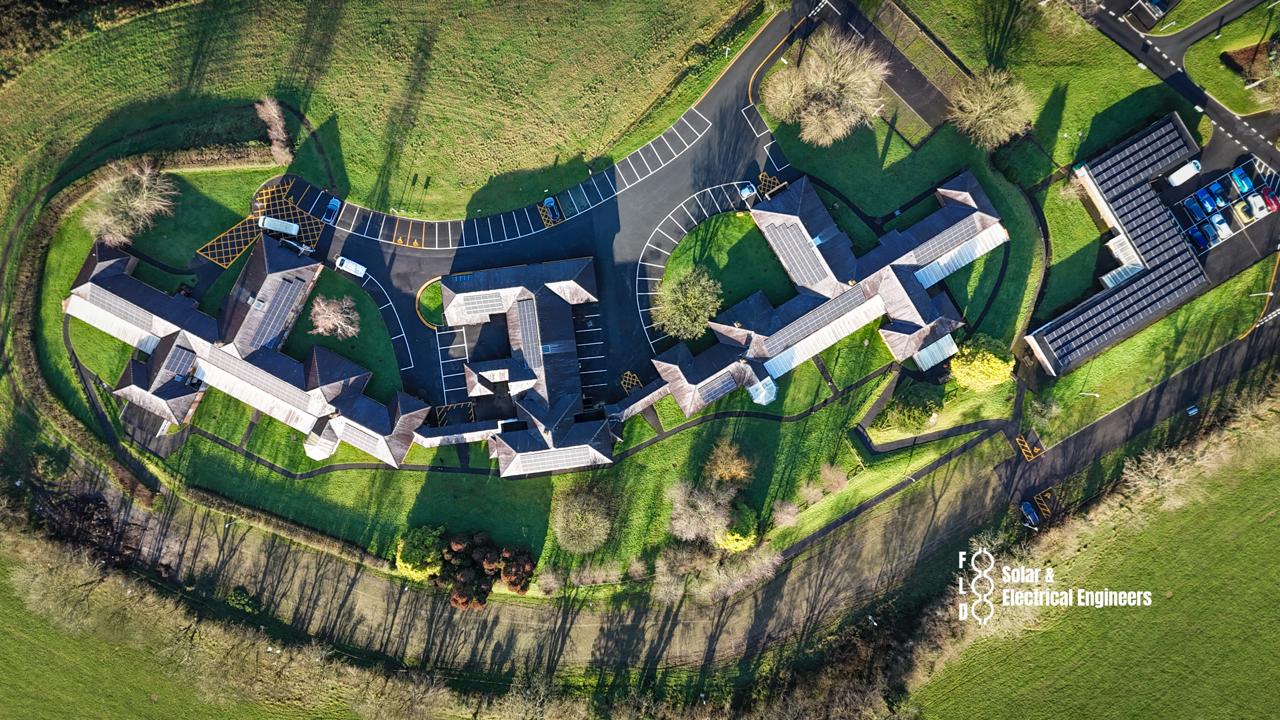
Swansea’s commercial solar opportunity is concentrated in a corridor that runs north from the city centre through Llansamlet, across Swansea Enterprise Park and west to Fforestfach. This is not the Swansea of the Marina or Dylan Thomas — it is the working city, and it is where FLD does most of its commercial rooftop work in SA1 through SA7.
Swansea Enterprise Park: the primary commercial target
Swansea Enterprise Park at SA6 8QR is the largest single concentration of commercial rooftop area in the FLD coverage zone. It spans the administrative boundary between Morriston and Llansamlet and carries over 200 business units in a mix of light industrial, logistics, professional services and trade-counter retail. The DVLA Morriston complex, at the north-east end of the park, is the single largest building on the estate.
At 950 kWh/kWp (the SA6 PVGIS baseline), a 100 kWp rooftop on a Swansea Enterprise Park logistics unit generates 95,000 kWh annually. With 75% self-consumption at 27p/kWh blended, year-one benefit is approximately £21,800 on £85,000 capex. Simple payback 3.9 years, post-tax payback 2.9 years once the Annual Investment Allowance is applied (100% in year one, up to the £1m annual cap).
Ynni Cymru capital grants are available for qualifying Welsh businesses across the SA6 postcode. For a system of this scale, a grant in the range of £25,000 to £45,000 reduces effective capex and pulls simple payback to 3.0 to 3.4 years before AIA. We handle the Ynni Cymru application process from the initial feasibility check through to grant offer as part of the project management service.
SA7 Llansamlet: warehouse and distribution rooftops
The Llansamlet industrial cluster in SA7 carries a different rooftop profile from Swansea Enterprise Park. The buildings tend toward larger distribution and storage units — longer spans, higher eaves, greater structural loading capacity, and in several cases south-east or south-west orientation that still delivers 88 to 95% of optimal yield compared with true south.
A 200 kWp system on a Llansamlet distribution building generates 190,000 kWh per year. For a 24-hour logistics operation drawing 280,000 kWh annually, self-consumption above 80% is achievable. Year-one benefit at those rates is approximately £43,500 on capex of £160,000. Simple payback 3.7 years; under Annual Investment Allowance the tax-adjusted payback falls to 2.7 years.
At this scale, a G99 Type A grid connection application to National Grid Electricity Distribution is required. G99 timelines for the SA7 network area are running at 10 to 16 weeks in 2026. We submit a NGED pre-application feasibility check before committing to a full G99 submission, confirming export capacity at the connection point and any local network constraint that would require a G-type export limiting device.
SA5 Fforestfach: retail and food processing
Fforestfach in SA5 covers a retail park, food processing operations and trade-counter units on the western edge of the city. The retail park profile — large flat roofs with south-facing aspect and minimal penetration — is technically ideal for ballast-mounted commercial arrays. Food-processing operations typically have continuous refrigeration and process-heat demand that produces high self-consumption ratios even on systems above 300 kWp.
For a food-processing building at Fforestfach running 18 hours a day with continuous refrigeration, a 150 kWp system generating 142,500 kWh annually at 950 kWh/kWp can achieve self-consumption of 85 to 90%. Year-one benefit on that profile is approximately £33,500 on capex of £124,000, with simple payback under 3.7 years.
EV fleet charging: the second payback lever
Swansea Enterprise Park and the SA6/SA7 corridor have the highest concentration of commercial fleet operators in the FLD coverage area. Logistics companies, trade-counter distributors and service-fleet operations are all moving through EV transition timelines driven by a combination of the Clean Air Zone consultation, ULEZ expansion pressure and corporate fleet decarbonisation targets.
The integration of rooftop solar with a commercial EV fleet charging infrastructure materially improves the business case for both investments individually. Solar reduces the unit cost of fleet charging to approximately 8 to 12p/kWh when self-consumed directly — less than a third of grid import costs. Fleet charging represents a guaranteed daytime load that anchors self-consumption above 80% even on overcast days when generation is partial.
For a fleet operator at Swansea Enterprise Park running 20 commercial vehicles with an average daily charging requirement of 80 kWh, solar generation of 180 kWp covers the charging demand in the summer months and provides meaningful contribution in winter. We model solar and EV charging together from the first site survey rather than treating them as separate projects.
Public sector: Swansea Council and health board buildings
City and County of Swansea operates a large estate of public buildings across SA1 through SA7, including school campuses, civic offices and community leisure centres. Welsh public-sector bodies access solar capital through the Salix Wales Funding Programme, which provides interest-free loans repaid from energy savings.
Swansea Bay University Health Board has set net-zero targets with specific milestones in 2030 and 2035. Morriston Hospital, with its continuous heating, ventilation and clinical equipment load, represents one of the most compelling self-consumption cases for large-scale rooftop solar in the coverage area. We have experience of NHS procurement frameworks and hold ConstructionLine accreditation that supports public-sector tendering through NPS Cymru.
Getting a Swansea commercial solar quote
FLD is based in Swansea. Survey availability for SA5, SA6 and SA7 commercial clients is within three working days as standard. For fleet operators, we provide an integrated solar and EV charging feasibility report at no charge prior to committing to a full site survey. Call Paul on 07913 117746 or use the contact page.