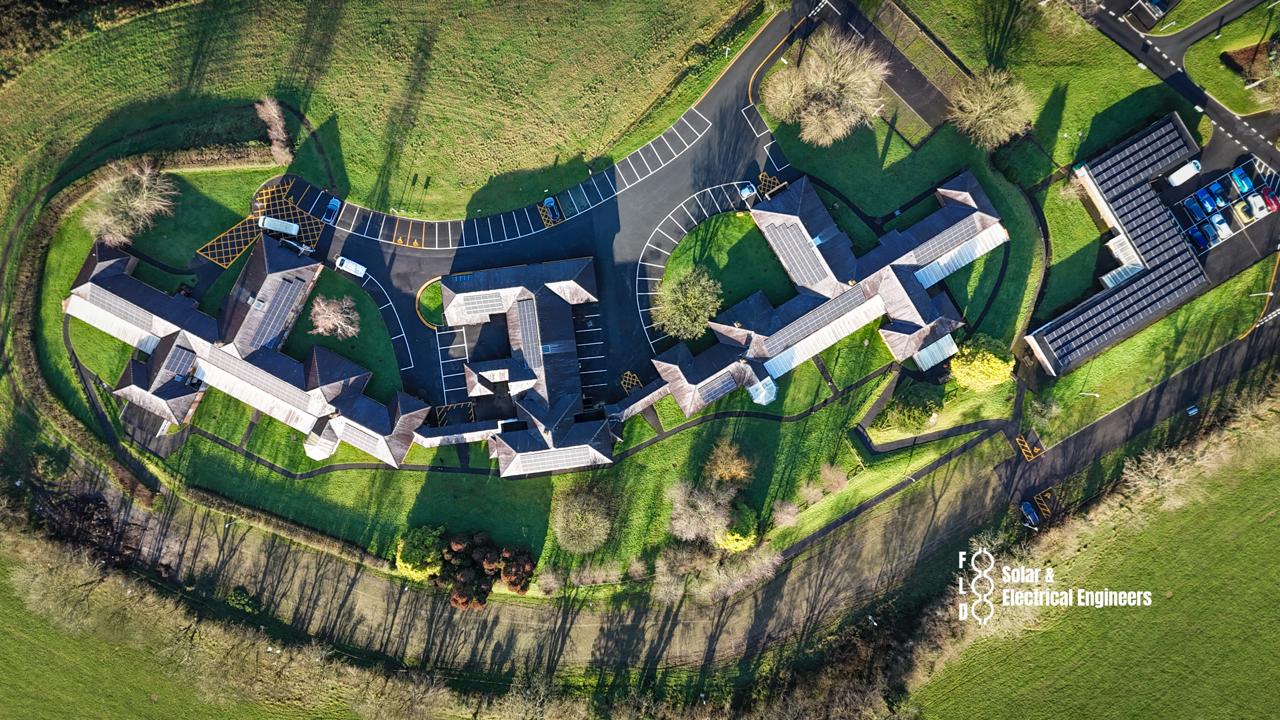
Welshpool, or Y Trallwng, sits on the Severn near the Welsh-English border in Powys. The SY21 postcode covers the town, Buttington, Pool Quay and the rural belt out to Guilsford and Berriew. For commercial solar the economy splits between the Welshpool Buttington light-industrial estate, a strong agricultural belt, a market-town high street, and the Powis Castle estate and its wider visitor economy.
SY21 solar yield
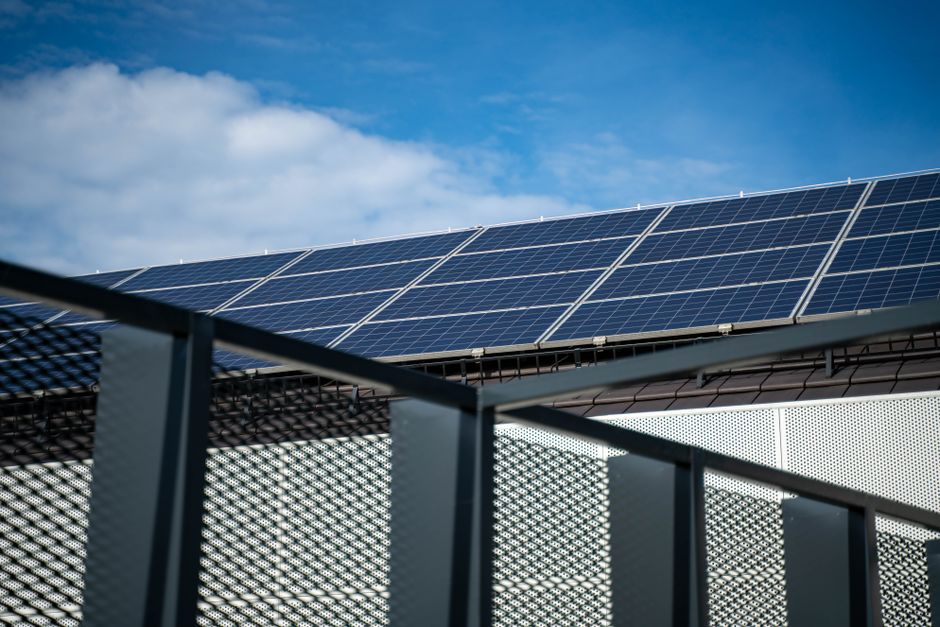
PVGIS returns 935 to 960 kWh per kWp per annum for a well-oriented rooftop array in SY21. The inland mid-Wales position gives strong winter direct-beam irradiance and reasonable summer yield, with ambient temperatures that keep panel efficiency high. Expect 46,500 to 48,000 kWh per year from a 50 kWp array.
Where solar lands cleanly in Welshpool
- Welshpool Buttington industrial estate - a substantial cluster of light-industrial units with 300 to 2,000 square metre rooftops. Typical installs are 50 to 300 kWp with clean aspects. Weekday daytime loads are well-matched to generation.
- Agricultural - the SY21 rural belt has substantial barn roofs suited to 50 to 300 kWp arrays. Self-consumption on mixed dairy and arable holdings typically 55 to 75 percent without batteries.
- Market town hospitality and retail - the High Street and Broad Street commercial frontage sits inside the Welshpool Conservation Area. Rear pitches and outbuildings typically work for rooftop PV.
- Livestock market and processing - the Welshpool Livestock Market at Buttington has concentrated weekday refrigeration and HVAC loads that correlate well with peak generation.
Powys County Council planning
Powys is consistent and pragmatic on rooftop PV. Key points:
- Permitted development applies outside the conservation area, subject to the 200 mm projection limit and the standard non-listed, non-scheduled-monument conditions.
- Inside the Welshpool Conservation Area, full planning permission is required. Officers assess visual impact from the High Street, Broad Street and Church Street public realm.
- Powis Castle sits within a registered historic park and garden, and any application on buildings within its visual setting will attract additional scrutiny.
- For agricultural buildings above 465 square metres new floorspace, prior approval under Part 6 of the GPDO applies; rooftop solar added during the same programme should be consolidated into the same submission.
Grid connection
SY21 sits in SP Energy Networks licence area (not NGED). G99 Type A application timelines are broadly similar to NGED at 6 to 8 weeks for 50 kW to 1 MW. Supply capacity is often the binding constraint on rural and light-industrial sites. Supply upgrades add 8 to 14 weeks and material cost.
What a Welshpool install typically looks like
A recent SY21 light-industrial install: 120 kWp across three pitches of a 1,400 square metre single-span shed, with the inverter plant sited in an external kiosk to preserve internal floor area. Year-one generation tracked PVGIS within 1.5 percent, self-consumption 76 percent against HH data, simple payback 5.9 years at prevailing electricity pricing.
Distance and logistics
Welshpool is a three-hour drive from our Swansea base. For projects of meaningful value we mobilise a full crew on a Monday-to-Friday deployment and batch trips across SY16, SY20 and SY21 where possible. The SP Energy Networks rather than NGED DNO difference is handled in our application preparation; it is administratively slightly different but not materially slower.
Starting the conversation
If you own or manage a commercial or agricultural property in SY21 and want an assessment including SP Energy Networks grid-connection considerations, call Paul direct on 07913 117746.