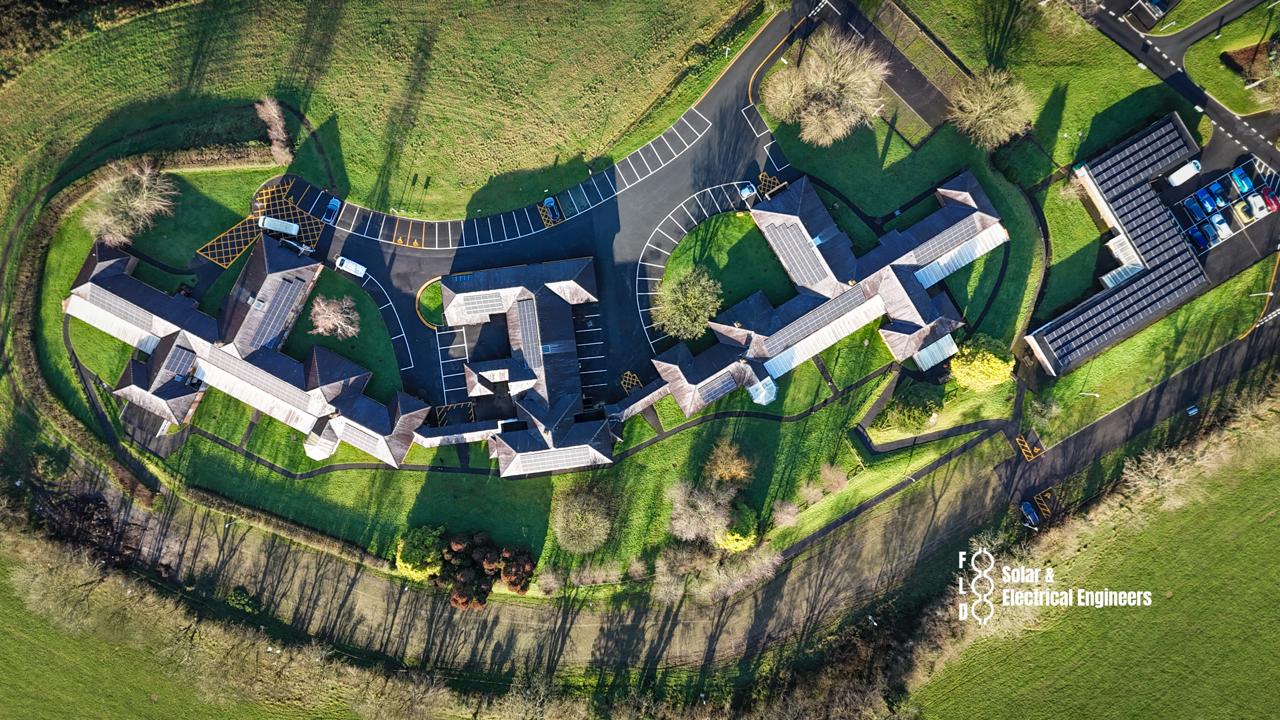
Usk sits in the Usk Valley between Abergavenny and Newport in Monmouthshire. The NP15 postcode covers the town, Llanbadoc, Gwehelog and the rural belt out to Raglan. For commercial solar the economy is a mix of high-quality hospitality, independent retail and food, a solid agricultural base, and a small light-industrial estate on the edge of town. Yields are strong, Monmouthshire planning is consistent, and NGED grid connection timings are predictable.
NP15 solar yield
PVGIS modelling for NP15 returns 955 to 980 kWh per kWp per annum for a well-oriented commercial rooftop at 30 to 35 degrees pitch. The inland eastern position gives slightly higher direct-beam irradiance than central South Wales and the Usk Valley’s sheltered microclimate helps ambient panel temperatures in summer. Expect 47,500 to 49,000 kWh per year from a 50 kWp array.
Where solar lands cleanly in Usk
- Hospitality - the Three Salmons, the Usk Town House and the cluster of independent restaurants have material daytime loads driven by refrigeration, prep cooking and HVAC. Self-consumption typically 65 to 80 percent without batteries.
- Agricultural - the NP15 rural belt covers arable, mixed livestock and some dairy. Barn roofs of 300 to 1,000 square metres regularly accommodate 50 to 200 kWp arrays with strong self-consumption.
- Light industrial - the estate off Porthycarne Street and the rural units along the A472 towards Raglan are clean installation environments with weekday daytime loads.
- Independent retail and services - the High Street and Bridge Street commercial frontage sits inside the Usk Conservation Area, which constrains visible-elevation arrays but rear and concealed aspects typically work.
Monmouthshire planning
Monmouthshire County Council has a consistent, pragmatic approach to rooftop PV. Key points:
- Permitted development applies outside the Usk Conservation Area, subject to the 200 mm projection limit and the usual non-listed, non-scheduled-monument conditions.
- Inside the conservation area, full planning permission is required. Officers assess visual impact from the public realm. Rear pitches and outbuilding roofs are typically approvable with all-black modules.
- The River Usk SAC constrains ground-mounted solar and any scheme involving groundworks near the river. Rooftop PV on existing commercial buildings is unaffected.
Grid connection
NP15 sits in NGED’s licence area. G99 Type A applications are consistent at 6 to 8 weeks. Supply capacity rather than consented solar rating is usually the binding constraint on rural sites. Supply upgrades from single-phase to three-phase add 8 to 14 weeks and material cost.
What a Usk commercial install typically looks like
A recent NP15 hospitality install: 42 kWp across two pitches of the main kitchen and function-room roof, inverter sited in the plant room, HH consumption data used to size a 20 kWh battery for out-of-hours reserve and shoulder-season self-consumption optimisation. Year-one generation tracked PVGIS within 2 percent, self-consumption 79 percent, simple payback 6.1 years at prevailing electricity pricing.
Distance and logistics
Usk is a 75-minute drive from our Swansea base. We service NP4, NP7, NP15 and NP25 on a regular rotation so mobilisation is efficient for projects of meaningful value.
Starting the conversation
If you own or manage a commercial or agricultural property in NP15 and want a frank assessment, call Paul direct on 07913 117746.