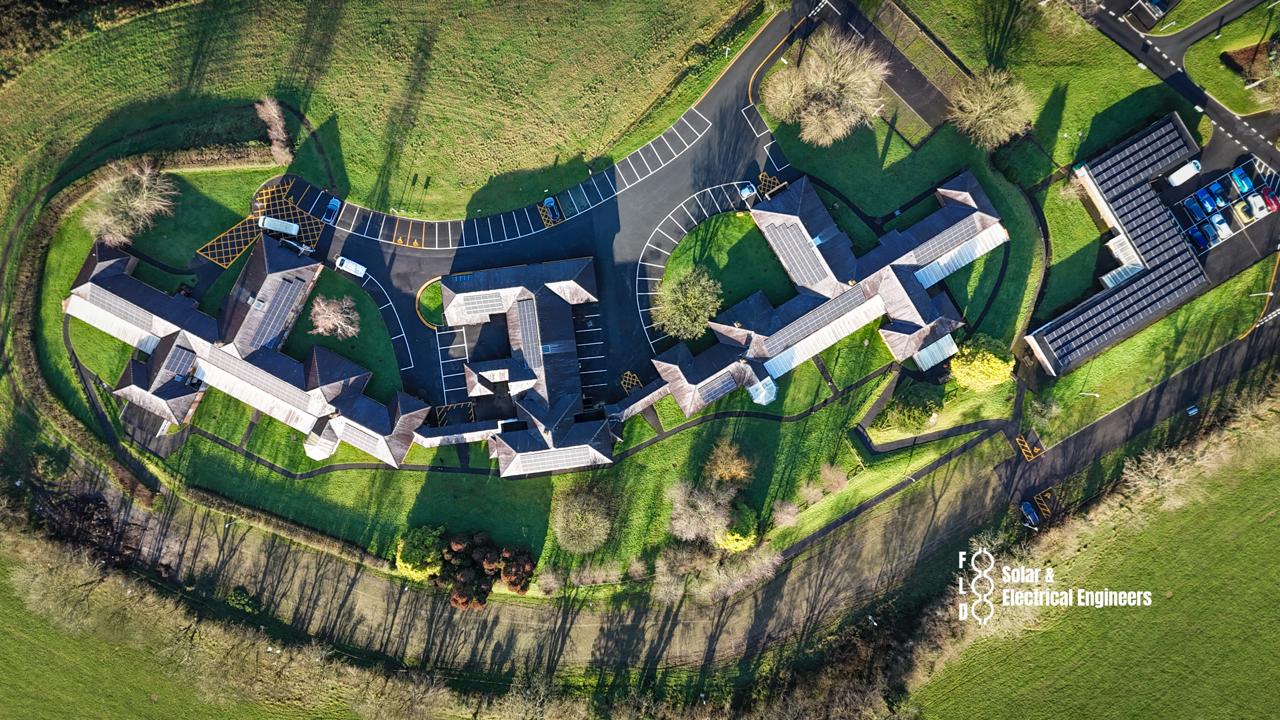
Llanelli’s commercial solar story — the Trostre Park retail operation, the Daewoo/Schaeffler bearing plant, the Parc Pemberton industrial estate — is set out in the SA14 commercial guide. This piece addresses the energy storage dimension that is increasingly inseparable from any solar investment discussion across SA14 and SA15.
Battery storage has moved from premium addition to near-standard specification for Llanelli solar projects over the past two years. The drivers are specific and quantifiable: Llanelli households have above-average daytime absence (commuting to Swansea and Carmarthen), which depresses direct solar self-consumption; SA14 electricity tariffs at 28 to 30p/kWh create a strong financial case for maximising on-site use; and EV adoption in the Llanelli catchment is accelerating, adding a predictable daily charging load that a battery-solar combination can cover cost-effectively.
Why battery storage improves solar economics in Llanelli
The core problem with solar-only installations in households where no one is at home during peak generation hours (10 am to 3 pm) is that the best generation periods coincide with the lowest consumption periods. A 4 kWp system on a Llanelli house with two working adults and no battery exports 55 to 65% of its annual generation to the grid at the Smart Export Guarantee rate of 5 to 12p/kWh. That exported unit is worth 2 to 2.5 times less than a unit consumed directly.
A 10 kWh battery captures daytime generation and dispatches it during the evening consumption peak. For a typical Llanelli working household, this shifts effective self-consumption from 38% to 68%, increasing year-one benefit from approximately £540 to approximately £850 — a £310 annual improvement on a battery costing £4,500 to £5,500 installed alongside solar.
At 960 kWh/kWp (the SA14/SA15 yield baseline), a 4 kWp system generates 3,840 kWh annually. With battery raising self-consumption to 68%, the year-one calculation is:
- Self-consumed generation: 2,611 kWh at 28p/kWh = £731
- Exported generation: 1,229 kWh at 13p SEG = £160
- Year-one benefit: £891
The combined solar-battery system at approximately £10,500 to £12,000 capex reaches simple payback of 11.8 to 13.5 years — competitive with solar-only in shaded valley catchments and significantly better in terms of energy independence.
Time-of-use tariffs: the battery multiplier
The financial case above uses standard grid electricity pricing. Time-of-use tariffs — Octopus Agile, Intelligent Octopus, E.ON Drive — materially improve the battery economics by enabling overnight cheap-rate grid charging during off-peak periods.
On Octopus Agile, overnight electricity between 11 pm and 6 am in South Wales typically averages 8 to 14p/kWh and can occasionally go negative. A battery charged overnight at 10p/kWh and discharged during the 4 to 7 pm peak at 29p/kWh generates approximately 19p/kWh spread on each cycle. On a 10 kWh battery cycling daily, that arbitrage produces an additional £690 per year independent of solar generation.
For Llanelli households already paying 28 to 30p/kWh peak tariff, the shift to a time-of-use structure with battery dispatch optimisation is typically worth £400 to £700 per year in tariff savings alone. We model this alongside solar generation at the initial survey rather than treating it as a separate conversation.
EV charging: the third revenue stream
Llanelli has seen strong EV fleet adoption from several of the larger employers at Daewoo/Schaeffler, Trostre and Delta 2000, and domestic EV adoption is tracking the national trend. For a Llanelli household with an EV covering 10,000 miles per year at 3.5 miles/kWh, annual charging consumption is approximately 2,860 kWh.
Solar-generated electricity charged into the EV battery costs approximately zero. Grid-charged electricity on a smart overnight tariff at 10p/kWh costs approximately £286 for the same 2,860 kWh that would cost £800 at standard rate. The combined solar-battery-EV system eliminates most of the EV running cost for the summer months and substantially reduces it year-round.
We install OZEV-approved smart EV chargers (7 kW single-phase, 22 kW three-phase for commercial fleet) alongside solar and battery as a single combined project. The shared consumer unit works reduce the combined installation cost compared with sequential individual projects.
Commercial battery storage: SA14 industrial applications
On the commercial side, battery storage in Llanelli is relevant primarily for demand-charge management. Large commercial and industrial sites are billed partly on their peak half-hourly demand — the maximum draw recorded in any 30-minute period during the billing cycle. A battery system can shave these demand peaks by discharging precisely when grid consumption would otherwise spike, reducing the demand charge component of the electricity bill.
For a SA14 manufacturing site with a 500 kVA supply and a demand charge tariff, peak-demand management through battery storage can reduce the distribution use-of-system charges by £8,000 to £18,000 annually, independent of any solar generation. Combined solar-battery at commercial scale requires detailed half-hourly interval data analysis at the design stage — we request 12 months of interval data from the site prior to producing a commercial storage recommendation.
Getting a Llanelli battery storage quote
FLD is 25 minutes from Llanelli by road. We cover SA14 and SA15 for solar, battery storage and EV charging as combined projects or standalone battery additions to existing solar installations. For existing solar owners in Llanelli who want to add battery storage retrospectively, we conduct a system compatibility check at no charge. Call Paul on 07913 117746 or use the contact page.